
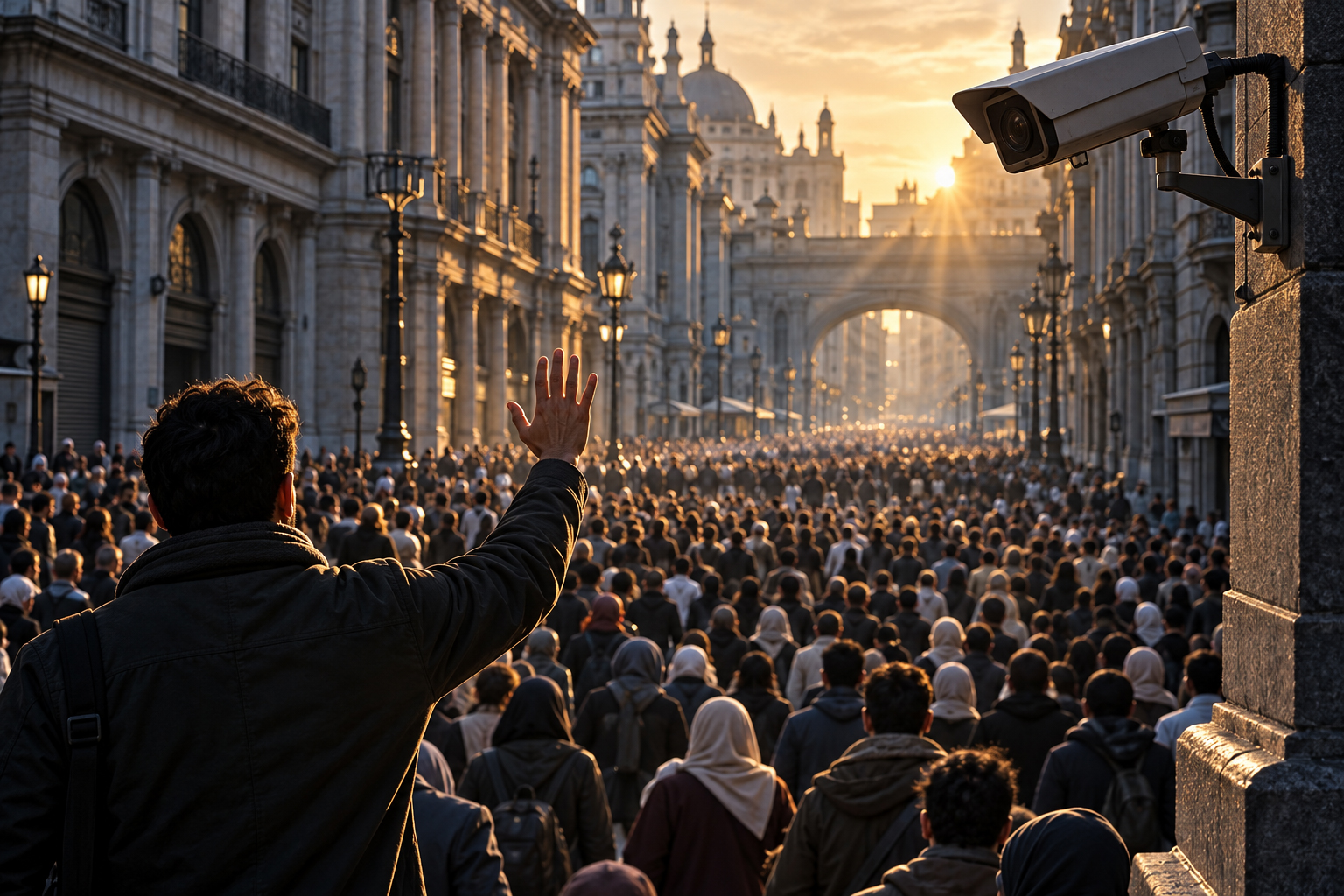




The article examines the growing crisis of confidence in the effectiveness of nonviolent action as authoritarian regimes develop increasingly sophisticated tools of repression. It argues that the problem lies less in the failure of civil resistance itself than in its declining ability to keep pace with surveillance, “smart repression,” and the widespread tendency to reduce strategic nonviolent struggle to mass demonstrations.
Writing in the October 2026 issue of the Journal of Democracy, Vol. 37, No. 4, Briza Reyes Maksimovic and Jamila Raqib argue that successful movements must move beyond mobilization and media visibility toward strategic planning, noncooperation, the construction of alternative institutions, stronger digital security, and systematic exchange of experience.
They also call for reconsidering how success itself is defined, rather than reducing it to the overthrow of governments. According to the authors, nonviolent resistance remains a method capable of evolving and adapting to an increasingly complex and repressive political environment.
The article states:
From Burma to Belarus, one question keeps recurring: Is nonviolent action still effective?
The authors argue that the theory has not failed. Rather, the field itself has failed to keep pace with developments. Authoritarian regimes have modernized their instruments of repression, while movements have increasingly reduced strategic nonviolent struggle to street protest and confused media visibility with the capacity to exert pressure.
This disparity helps explain why organizers facing lethal repression sometimes turn to arms, even though nonviolent campaigns continue to outperform violent ones.
The authors also challenge the way success is measured. Standards centered on the removal of a leader or a single political cycle can obscure meaningful achievements. What the field needs now is not a new doctrine, but investment in countering smart repression, rebuilding strategies of noncooperation, and transferring lessons from one movement to another.
Over the past several years, we have found ourselves having remarkably similar conversations in very different contexts.
Whether discussing Russia’s invasion of Ukraine, democratic backsliding in Europe and Latin America, military rule in Burma, or the repression of pro-democracy movements from Hong Kong to Belarus, someone eventually asks some version of the same question: Is nonviolent action still effective?
We listen to these conversations with growing concern because both of us have spent much of our professional lives studying, teaching, and supporting strategic nonviolent action, following the approach developed by Gene Sharp and further advanced by researchers and practitioners around the world.
Increasingly, we face not only doubts about whether nonviolent action is appropriate for particular campaigns, but doubts about the approach itself and whether it remains relevant to today’s political realities.
Over the past quarter century, even where mass mobilization succeeded in removing leaders, many movements subsequently struggled to secure durable democratic gains.
Skepticism has replaced much of the optimism that once surrounded the “color revolutions,” the Arab Spring uprisings, and other popular movements.
Georgia’s 2003 Rose Revolution, Ukraine’s 2004 Orange Revolution, and the 2011 uprisings that removed long-serving rulers in Tunisia and Egypt were once regarded as evidence that the model worked. Yet several of those same countries have since experienced democratic backsliding or the return of other forms of authoritarian rule.
These doubts are understandable.
Democracy is under pressure around the world, while authoritarian governments have become more sophisticated. Digital surveillance, disinformation, and new forms of repression have transformed the environment in which movements operate.
Recent research only reinforces that impression.
According to the V-Dem Institute’s 2026 Democracy Report, democracy has fallen back to levels last seen in 1978, effectively erasing the gains of the “third wave” of democratization.[1] Today, nearly three-quarters of the world’s population lives under authoritarian rule.
For some, the conclusion seems obvious: nonviolent action has become obsolete. Authoritarian governments have learned. Technology has shifted the balance of power. The world has changed.
But we believe this diagnosis confuses the symptoms with the underlying cause.
The fact that many contemporary movements have failed to meet expectations does not prove that the fundamental theory of nonviolent struggle has failed.
Instead, it reveals an innovation gap.
While authoritarian regimes have invested heavily in adapting to the changing political environment, the field of nonviolent action has not evolved at the same pace.
The result is not the failure of strategic nonviolent struggle as a method, but a widening gap between movements and the adversaries they seek to challenge.
This distinction matters.
If people conclude that nonviolent action no longer offers a realistic path to political change, only two alternatives remain: submission or violence.
Neither offers much reason for optimism.
At the same time, it would also be difficult to justify accepting the effectiveness of violence. Armed struggles, insurgencies, and military interventions rarely achieve their political objectives, even before accounting for the human costs involved, and they often leave societies more divided, authoritarian, and unstable than before.
The challenge, therefore, is not to abandon nonviolent struggle, but to improve it.
We make our argument in four steps: diagnosing where the current model of nonviolent action has fallen behind; directly confronting the attraction of violence generated by that gap; correcting the way success itself is measured; and identifying what must be built for a modernized and more capable field of nonviolent action.
A Crisis of Confidence
The belief that nonviolent action is no longer effective did not emerge from nowhere.
Researchers have documented a decline since 2010 in the success rates of nonviolent campaigns pursuing maximalist demands compared with previous decades.[2]
Activists themselves increasingly express frustration that large demonstrations generate enormous public attention but produce relatively few tangible political gains.
Movements capable of mobilizing hundreds of thousands of people frequently find themselves unable to convert public anger into durable shifts in political power.
These frustrations are real and deserve to be taken seriously.
But they also raise an important question: if movements are becoming less successful, what exactly has changed?
Was the underlying theory flawed from the beginning, or does the theory remain largely sound while its application has failed to keep pace with a changing political reality?
We believe the evidence overwhelmingly supports the second explanation.
Strategic nonviolent action was never synonymous with protest alone.
Gene Sharp devoted relatively limited attention to demonstrations compared with the extensive attention he gave to strategic planning, institution-building, noncooperation, and power analysis — elements he regarded as essential to successful struggle.
Protest was merely one of roughly two hundred methods of nonviolent action he identified, and often not the most consequential.
More importantly, Sharp consistently argued that nonviolent struggle should be understood as an evolving field of strategic practice, not as a fixed doctrine.
Far from presenting a completed theory, he repeatedly emphasized that future generations would have to refine, test, and improve it in response to changing circumstances.[3]
Ironically, much contemporary activism has reduced this rich strategic tradition to its most visible tactical expression: mass demonstrations.
That trend deserves direct examination because it explains more of the current crisis of confidence than any single change in authoritarian tactics.
Protest Is Not a Strategy
Today’s movements have become exceptionally skilled at mobilizing public protest.
Digital communication has dramatically reduced the cost of organizing demonstrations and attracting media attention.[4]
Within hours, thousands — even millions — of people can gather in public squares around the world.
What has not expanded at the same pace is the strategic capacity required to transform mobilization into movements capable of surviving, securing gains, and defending those gains over time.
Many movements today invest heavily in communications, reflecting a broader tendency to frame strategic challenges as communications problems.
In an era dominated by digital media, the assumption that changing the narrative will itself change the balance of power has become increasingly influential.
International support for movements has often reflected the same emphasis, prioritizing communications over the slower and less visible work of strategic planning and organizational capacity-building.
The result is that movements become highly effective at generating visibility but struggle to identify the institutions sustaining an opponent’s power, determine how those pillars of support might be weakened, or plan campaigns over months and years rather than days and weeks.
Perhaps more importantly, movements increasingly imitate what cameras capture rather than what actually produces political change.
Images of packed streets capture public imagination.
But decisive work often takes place elsewhere: in behind-the-scenes planning, training designed to build internal discipline, efforts to win allies, economic noncooperation, and the construction of alternative institutions capable of sustaining resistance over extended periods.
These dimensions of struggle are rarely visible to outside observers.
As a result, movements often reproduce the outward appearance of successful campaigns while overlooking the strategic architecture that made those campaigns effective.
The result is street protest without sufficient strategic leverage.
This does not mean visibility never matters.
Viral videos in 2025 showing U.S. Immigration and Customs Enforcement officers forcing bystanders to the ground and detaining U.S. citizens did real political work. They helped generate a wave of lawsuits by cities seeking to constrain federal enforcement authority and prompted some jurisdictions to demand that officers stop concealing their faces.
Documentation can shift elite opinion and open legal fronts that might otherwise not exist.
The point is narrower: virality is not a strategy in itself.
A video that spreads widely without an organization positioned to convert the resulting outrage into litigation, legislation, or noncooperation will fade as quickly as it spread.
Meanwhile, Authoritarians Were Learning
If movements have not evolved fast enough, authoritarian regimes certainly have.
Many authoritarian governments now systematically study successful nonviolent movements and have adjusted their responses accordingly.
Russian military thinking explicitly acknowledged the growing strategic significance of nonmilitary forms of conflict.
In 2013, General Valery Gerasimov wrote that “the very rules of war have changed” and that “the role of nonmilitary means of achieving political and strategic goals has grown.”[5]
One consequence of authoritarian regimes’ expanded understanding of nonviolent struggle is that they increasingly recognize that violent repression can backfire.
Heavy-handed violence can strengthen opposition by generating public outrage and international sympathy and can encourage members of the security forces and government officials to defect.
Instead of relying primarily on mass repression, authoritarian governments increasingly employ what researchers describe as “smart repression”: selective arrests, legal harassment, financial pressure, digital surveillance, online disinformation, infiltration, and carefully calibrated violence designed to fragment movements without triggering a broad public backlash.[6]
Patience itself has become a weapon.
Increasingly, governments do not need to risk a dramatic crackdown if they can simply outlast the movement.
They can calibrate pressure on individuals through prosecutions, travel bans, asset freezes, pressure on family members who remain inside the country, and similar measures until exhaustion rather than defeat ends the campaign.
Hong Kong provides perhaps the clearest example.
Following the 2019 protests, Beijing did not need mass violence to close political space.
The 2020 National Security Law and the 2024 enactment of Article 23 legislation accomplished much of that work through prosecutions, the forced closure of more than one hundred civil-society organizations and trade unions, and a wave of organizer emigration.
Many concluded, with reason, that the government was prepared to wait years rather than weeks to exhaust them.
A movement built to withstand a decisive confrontation is not necessarily built to withstand a five-year siege consisting of hundreds of individual cases.
That is a different kind of problem that the field must address, and it is no less urgent than the challenge posed by violent repression.
Emerging technologies have accelerated this transformation.
Artificial intelligence, facial recognition, social-media monitoring, and sophisticated surveillance systems have dramatically reduced the cost of identifying activists, mapping their networks, and disrupting collective action before it reaches critical mass.
These capabilities are increasingly transnational.
Opposition movements today confront not only domestic security agencies, but an ecosystem of surveillance vendors, disinformation operators, and financial intermediaries whose services movement opponents can effectively rent by the month.
Organizers in exile are also pursued across borders.[7]
Preemptive arrests timed to disrupt mobilization before it coalesces have become a routine feature of authoritarian statecraft rather than an exception.
These innovations do not invalidate the fundamental dynamics of nonviolent struggle.
But they do change the environment in which those dynamics operate.
Just as military strategy evolves in response to changes on the battlefield, democratic movements must do the same.
This adaptation is not merely tactical.
It increasingly concerns what happens to the discipline of nonviolent resistance when a regime concludes that repressing those who pose a serious threat to it — including through its most sophisticated methods — is an acceptable and necessary cost of remaining in power.
The Pull Toward Arms
There is one version of this argument that we have not yet addressed directly, and it is one we increasingly hear from young organizers themselves:
What happens when the moral logic of nonviolent discipline collides with the daily experience of violent state repression?
Burma offers the clearest contemporary answer, and it is not a comfortable one.
When Burma’s military seized power in February 2021, the response took the form of one of the most sophisticated civil-disobedience movements in recent memory.
Civil servants left their jobs and paralyzed the bureaucracy.
Bank employees refused to process transactions, freezing the junta’s access to revenue.
Garment workers, railway employees, and medical personnel joined a general strike that, for a time, made the country almost ungovernable through noncooperation alone.
It was strategy in the Sharp tradition, implemented with genuine sophistication, and it worked for months.
Then the junta escalated.
Security forces opened fire on peaceful crowds, killing hundreds of protesters in the campaign’s first months, with the death toll eventually rising into the thousands.
In 2024, the regime imposed military conscription on men and women in their twenties.
Since then, tens of thousands of young people who had spent 2021 on picket lines have been forced either into military uniforms or into flight to avoid conscription.
Faced with a military prepared to shoot unarmed strikers in the streets and then conscript the survivors, many of the young people who built the Civil Disobedience Movement concluded that nonviolent discipline was a luxury they could no longer afford.
Many crossed into territory controlled by ethnic armed organizations to receive weapons training before returning as fighters in People’s Defense Forces allied with the parallel National Unity Government.
It would be dishonest to lecture people about nonviolent discipline while they watch their friends die in the streets.
Their reasoning is not irrational.
When a state has already decided to answer noncooperation with bullets, continued adherence to a nonviolent approach can appear impossible.
We understand why many concluded that armed resistance was the only path left.
But the strategic argument against that conclusion, however uncomfortable, still deserves to be made.
Armed insurgency is precisely the outcome authoritarian planners hope to provoke because it gives them what mass nonviolent noncooperation denies them: a justification for martial law, a “terrorism” frame that erodes international sympathy, and a battlefield on which the state’s superiority in weapons and numbers finally becomes decisive.
It also narrows the coalition.
Once a movement goes underground and takes up arms, a movement previously sustained by civil servants, retirees, monks, teachers, and others becomes disproportionately a movement of young men.
That is a much narrower constituency from which to defend a democratic transition than the coalition that built the original strike.
After five years of armed resistance in Burma, ethnic armed organizations and People’s Defense Forces have indeed captured significant territory from the junta.
Yet the country has not moved measurably closer to a democratic settlement, while the human cost of a civil war with no clear endpoint continues to rise.
Syria followed a similar path after 2011.
A broad-based and largely nonviolent protest movement confronted escalating regime violence and militarized within a year.
The result was not liberation, but more than another decade of war and mass displacement, and ultimately a different authoritarian outcome from what either side had initially intended.
The data reinforce the point.
Erica Chenoweth and Maria Stephan’s landmark study of major resistance campaigns between 1900 and 2006 found that nonviolent campaigns succeeded in 53 percent of cases, compared with 26 percent for violent campaigns.[8]
The difference becomes even wider afterward.
Countries in which a nonviolent campaign prevailed had, five years later, roughly a 40 percent chance of being democratic.
Among countries in which an armed insurgency prevailed, the probability was below 5 percent.
Nonviolent transitions were also far less likely to relapse into civil war within a decade.
Part of the explanation is the cost of participation.
An armed campaign requires weapons, supply lines, and fighters willing to risk death in combat.
That confines participation to a narrow core, predominantly highly committed young men.
A nonviolent campaign asks people to stay away from work, block a road, or refuse to process an official transaction.
That is a much lower threshold for participation, and it allowed Burma’s Civil Disobedience Movement, during its first weeks, to draw judges, bank employees, grandparents, and students into the same struggle.
This participation gap is not an incidental factor in the outcome.
Chenoweth’s research finds that mass participation is the single strongest predictor of campaign success.
And mass participation is precisely what movements sacrifice when they adopt violence as their primary means of achieving change.
We do not interpret this pattern as evidence that nonviolent action simply fails once repression becomes lethal.
We interpret it as the clearest manifestation of the innovation gap we are describing.
Movements confronting this level of violence do not choose between nonviolent action and armed struggle in a vacuum.
They choose between a strategic tradition that, in its current form, offers them limited practical guidance for organizing under mass killing and conscription, and an armed alternative that at least gives them a sense of agency.
Moral appeals are inadequate in this context.
Preventing this shift requires something more practical.
Until that happens, escalating repression will continue pushing people from picket lines to front lines.
Rethinking Success
The current crisis of confidence also reflects the way we judge the results of nonviolent struggle.
Observers often assess such campaigns according to standards they would never apply to violent conflicts.
When an armed rebellion topples a dictatorship and is followed by years of instability or renewed authoritarianism, few conclude that violence itself has therefore been disproved.
We understand that conflicts unfold over long periods, victories are often partial, and political gains require sustained defense.
Nonviolent struggle deserves the same analytical standard.
Many campaigns succeed in achieving their immediate objectives but fail to produce long-term democratic consolidation.
Others secure incremental gains that become the foundation for later achievements.
Democratic transition is an ongoing process.
Institutions require sustained defense long after any initial breakthrough.
Treating anything short of complete democratic transformation as failure obscures real strategic achievements and unnecessarily reinforces public pessimism.
Closely related is a leader-centered framework that treats regime change as the only recognizable outcome.
But most contemporary struggles do not fit that model.
They defend democratic space against backsliding.
They protect election results from captured institutions.
They prevent bad laws from being enacted and compel governments to reverse policies.
They open political space for coalitions that otherwise could not have emerged.
Each of these is a real political outcome.
Yet none produces an image of a strongman leaving the presidential palace, so all are often classified as “no result.”
There is also a distortion created by time.
The women’s suffrage movement in the United States took seventy years.
Ending racial segregation took decades.
The American civil-rights movement was a century-long project consisting of multiple and distinct phases.
Contemporary movements, by contrast, are often expected to achieve systemic transformation within a single electoral cycle, while news cycles and social media train participants to regard any campaign that has not fully succeeded within twelve months as a failed campaign.
Few of the movements Sharp studied would ever have passed that test.
Belarus illustrates the temporal dimension sharply.
The mass protests that followed the disputed 2020 election were crushed, thousands were imprisoned, and Alexander Lukashenko remains in power six years later.
By the standard of a single political cycle, the campaign appears to have been an unequivocal failure.
But the “Stop the Cockroach” networks and the culture of satirical resistance built during the 2020 campaign did not disappear.
They moved underground, sustained opposition institutions in exile, documented abuses, and preserved a base of civic identity that a thoroughly repressive government has been unable to eliminate completely.
There is no way to know in advance whether this latent capacity will one day reemerge as an open campaign for political change.
That is precisely the point.
Declaring it dead and buried after six years tells us more about our impatience than about the campaign’s ultimate trajectory.
Perhaps more importantly, we struggle with the counterfactual.
We measure movements against where we hoped they would take us, not against where we might have been had they never existed.
Everything a movement prevents — a worse law that never passes, a coup attempt that fails, a constitutional amendment that is blocked — remains largely invisible in assessments.
Prevention is invisible.
This method of measurement also distorts learning.
Movements frequently fail to document their own successes, while observers draw simplified lessons from highly visible episodes.
The myth of the spontaneous revolution persists because planning, training, strategic adaptation, and organizational development remain largely invisible from the outside.
Each new generation therefore begins again from zero instead of systematically building upon accumulated experience.
Lessons are neither adequately documented nor transferred across regions.
The Success We Overlook
Consider three recent episodes that are rarely counted as victories because none ended with the televised spectacle of a strongman leaving a presidential palace.
In Guatemala, after Bernardo Arévalo won the 2023 presidential election on an anti-corruption platform, prosecutors aligned with the outgoing government spent months attempting to overturn the result.[9]
Indigenous authorities, led by the traditional leadership of the 48 Cantons of Totonicapán, responded not with a single protest but with one hundred days of highway blockades, more than one hundred road closures across the country, and a continuous day-and-night encampment outside the attorney general’s office.
There was no single decisive march.
Instead, sustained noncooperation made the country increasingly difficult to govern until the effort to overturn the election collapsed.
Arévalo was sworn into office in January 2024, several hours late.
The communities that carried out the campaign remain frustrated that their victory did not grant them a seat at the government table.
Both realities can be true at once: a coup was prevented, and the exclusion that contributed to it was not resolved.
In India, after the government passed three deregulation laws in September 2020 that threatened farming communities, hundreds of thousands of farmers spent more than a year in camps along the roads leading to Delhi.
Rather than simply marching through the capital, they obstructed supply routes.
The government attempted to outlast the farmers, but it could not.
In November 2021, Prime Minister Narendra Modi repealed all three laws, an outcome few analysts believed a government with a comfortable parliamentary majority would accept.[10]
As we write this article, the “Cockroach Junta” party, a youth-led anti-corruption movement, has succeeded in forcing the country’s education minister to resign through humor, hunger strikes, and mass demonstrations — another significant victory against the ruling party.
In Bolivia, when a rebellious general led tanks into the central square in La Paz, where the presidential palace and National Congress are located, the June 2024 coup attempt did not fail because it was defeated in battle.[11]
It failed because rival politicians, the public, and a significant part of the military itself refused, within three hours, to treat the coup as legitimate or provide the cooperation it required.
Gene Sharp had long argued that coups are not isolated events but political processes whose success depends on securing the obedience and cooperation of key institutions.[12]
Rather than overthrowing a government, the achievement in Bolivia was preserving a democratic system before the coup could consolidate itself.
This is a type of victory that rarely enters the popular narrative of civil resistance because nothing visibly changed hands.
None of these cases produced the simple story the world has been trained to look for.
Yet all three altered the balance of power.
Guatemala prevented the annulment of an election.
India forced a government to reverse a major policy.
Bolivia’s institutions refused, in real time, to legitimize a coup.
If success requires the collapse of a regime, none of this counts.
If success means a measurable transfer of power away from those who misuse it, all of these cases count.
A New Generation of Nonviolent Strategy
The answer is neither to treat Gene Sharp’s work as a completed doctrine nor to abandon the strategic logic of nonviolent struggle.
It is to continue developing the field he helped establish.
The central idea remains unchanged: political power still depends on the cooperation of institutions and populations, and even highly repressive governments remain vulnerable when that cooperation is strategically withdrawn.
Like every field of strategic practice, nonviolent action must evolve in response to changing political realities.
That means understanding how authoritarian adaptation has reshaped the strategic environment, documenting successes and failures more systematically, transferring innovations across contexts, developing practical training tools, and making decades of accumulated knowledge more accessible than dense academic literature or isolated case studies currently allow.
None of this requires waiting for a grand unified theory.
It requires a relatively short list of concrete investments that organizations supporting movements, academic institutions, and funding bodies can begin making now.
Several priorities stand out.
Priority One: Develop Systematic Responses to Smart Repression
Digital-security knowledge must become a basic organizing skill, not a specialist add-on.
Movements should explicitly plan for the preemptive arrest of key organizers, prepare successive layers of replacement leadership before repression begins, and study the opponent’s adaptations with the same seriousness with which opponents study ours.
Authoritarian “playbooks” now have research budgets.
The field of civil resistance needs the same.
Priority Two: Deliberately Move Away From Excessive Reliance on Demonstrations
Marches are useful, but they are insufficient.
The strategically decisive tactics in many successful modern campaigns have been forms of economic, political, and social noncooperation that impose a continuing cost on the opponent’s exercise of power.
Examples include Indian farmers blocking supply routes into Delhi and roadblocks in Guatemala that paralyzed commerce.[13]
Movements need to rebuild their capacity to organize within different groups and sectors, including workers, civil servants, businesses, and religious communities, because that is where the actual pillars of support are located.
If there is one observation we regard as most important, it is this:
The problem that “protest is not a strategy” is not peripheral.
It is the central obstacle standing between mobilization and power.
The effectiveness of noncooperation strategies depends on context.
When such strategies target security forces, for example, they may operate differently in countries where soldiers are poorly paid conscripts drawn from the same communities as protesters than in countries where security forces are highly professionalized and deeply integrated into the ruling system.
Strategic planning therefore begins not with selecting tactics, but by identifying where actual leverage and pressure points exist.
Priority Three: Build Alternative Institutions
Sudan’s Resistance Committees — a loose network of small neighborhood groups that began forming early in the 2010s after Omar al-Bashir’s regime violently suppressed a major protest and that remain active today — represent one of the most important institutional innovations in contemporary civil resistance.[14]
They were not merely bodies coordinating protest.
They functioned as parallel governance structures that administered services and mediated disputes.
Movements that build mutual-aid networks, schools, alternative media, and community-defense structures are far better positioned to sustain long struggles and survive repression.
This tradition, drawing on Gandhi’s constructive program and Ella Baker’s emphasis on community organizing, should be fully incorporated into the way the field of strategic nonviolent action teaches strategy.[15]
Every campaign should leave behind organizational capacity that did not exist before it began.
Similar constructive work is taking place elsewhere.
The Gen Z-led mutual-aid and legal-defense networks in Kenya that emerged from the 2024 Finance Bill protests, as well as the community kitchens and free clinics that helped sustain Sri Lanka’s Aragalaya movement in 2022, all built organizational infrastructure that survived beyond the protests that created them.
Priority Four: Invest Seriously in Cross-Movement Learning
During the March 2025 protests in Belgrade, for example, student organizers built a simple safety system into their security planning to help preserve the movement’s nonviolent discipline.
Student marshals wore yellow vests identifying them as responsible for maintaining order within the crowd and carried blue smoke flares.
If violence broke out or provocateurs infiltrated the protest, the marshals would ignite the blue smoke, remove their vests, and leave the gathering.
Without any microphone being required, this sent an immediate signal to everyone that it was time to go home.
This is a small example of a much larger pattern: local tactical innovations solve problems that nearly every movement eventually confronts, but they rarely leave the country in which they were developed.
Every movement today is reinventing methods of maintaining discipline, countering infiltration, coordinating in decentralized ways, and combating disinformation because insufficient infrastructure exists to transfer what works from one struggle to another.
Building that infrastructure may be the highest-impact investment the field can make.
Priority Five: Training and Experiential Learning
This is different from cross-movement learning, which concerns transferring what other movements have already discovered.
Training is about giving organizers repeated, low-risk practice that helps them develop judgment under pressure.
Nonviolent action is a practice, and practices are learned by doing.
But mistakes in this field can carry catastrophic personal and political costs, while the current training model, which relies heavily on outside experts, cannot be scaled to meet global demand.
What the field urgently needs are tools that allow movements to practice safely: simulations, tabletop exercises, scenario training, peer-led workshops, and digital resources that groups can use without depending on outside experts.
These five priorities are not sequential and are not ranked by importance.
Movements that wait to build alternative institutions until they have mastered digital security, or postpone cross-movement learning until a formal training infrastructure exists, will wait indefinitely.
In practice, progress in any one of these areas tends to depend on progress in the others.
Behind all of them lies a broader claim:
The field of civil resistance should be treated as an ecosystem to be built, not as a set of doctrines to be transmitted.
That means investing in the connective tissue: documentation infrastructure, training tools, and peer networks that allow a lesson learned in one struggle to reach the next struggle in time to make a difference.
This is the work of organizations such as the Albert Einstein Institution, organizations researching nonviolent conflict, CANVAS, and other actors operating at regional levels.
It is also the work of movements themselves, which need to treat documenting their experiences as strategic work rather than as a distraction from the “real work.”
It is equally the responsibility of funders, who need to support those parts of the field that do not look compelling in photographs but are ultimately where power is developed and exercised.
In practice, this includes human-rights and democracy funders, diaspora giving circles, and the small number of participatory grantmaking funds in which people affected by an issue help determine what receives funding.
Some have already begun experimenting with rapid, low-visibility support for capacity-building and educational work.
Most importantly, activists must rediscover that effective nonviolent struggle is not defined by the size of demonstrations, but by its ability to change the balance of power.
Recent innovations already point toward this future.
The signaling systems developed by Serbian students to preserve discipline during protests, new digital-security practices, and emerging methods of decentralized organizing all demonstrate that movements continue to innovate.
During the 2020 protests, Belarusians organized “courtyard chat” networks — highly localized Telegram channels built around the courtyards of individual apartment buildings rather than a centralized leadership structure, leaving no single leadership that could simply be arrested.
During Sudan’s 2019 revolution, protesters at the Khartoum sit-in established their own checkpoints at the entrances.
Volunteers searched people entering the site for weapons and required personal references to help identify infiltrators.
These measures proved critically important in maintaining nonviolent discipline against attempts to provoke a violent response.
Yet innovations of this kind often remain isolated rather than becoming part of a shared body of strategic knowledge.[16]
If democracy is to preserve its resilience in a century increasingly moving toward authoritarianism, that must change.
The next generation of nonviolent struggle will not succeed by repeating the tactics of the previous generation.
It will succeed by approaching civil resistance with the same spirit that has always driven its greatest advances: close observation, systematic learning, continuous adaptation, and the sharing of what has been learned.
Nonviolent action is not merely a collection of techniques or a philosophy of protest.
It is — and must remain — an evolving technology of political struggle.


Comments