
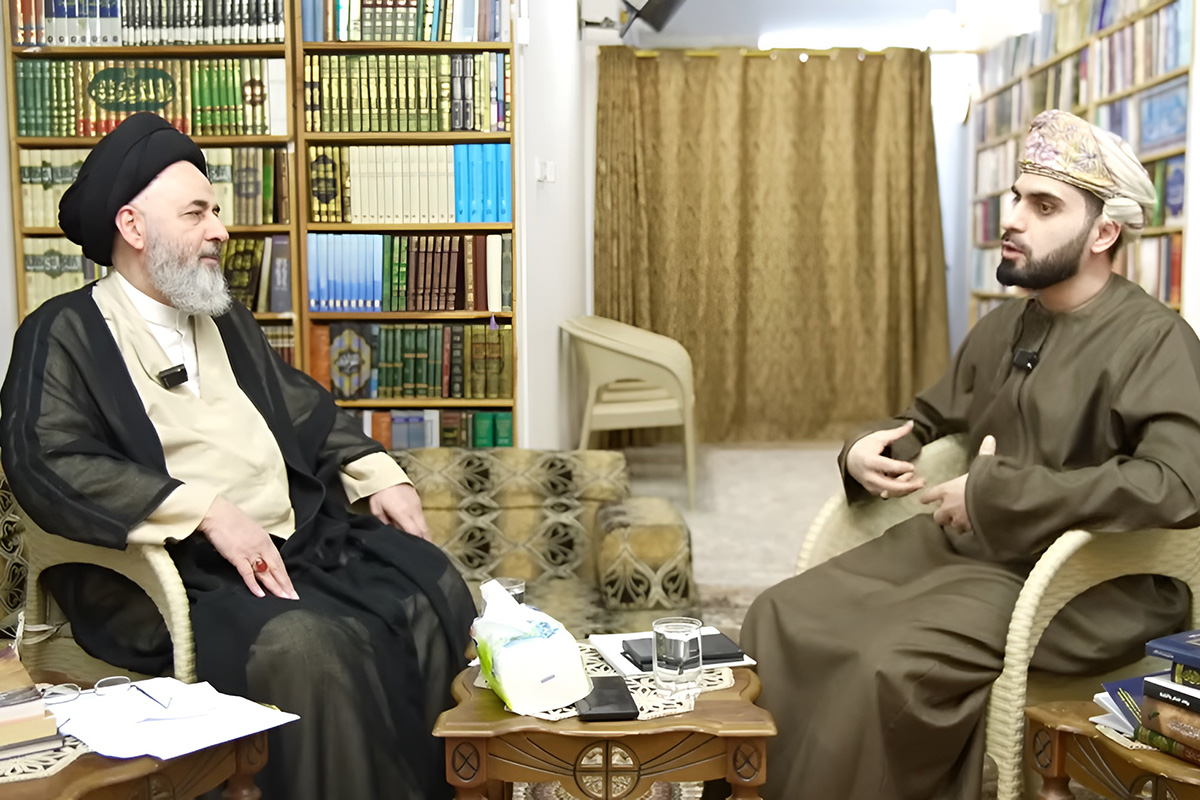




In an extensive intellectual and jurisprudential conversation, Hadi Mohammed al-Lawati, host of the Hira channel, speaks with His Eminence Ayatollah Sayyid Murtadha al-Husayni al-Shirazi, an advanced-level lecturer at the Islamic seminary and the author of numerous works on jurisprudence, principles of jurisprudence, theology, intellectual thought and Islamic economics. The interview was conducted in the holy city of Najaf, near the shrine of Imam Ali ibn Abi Talib (peace be upon him).
The discussion begins from the school of the Ahl al-Bayt (peace be upon them) as an epistemological and ethical reference point, but does not remain within a purely theoretical framework. It moves into contemporary questions involving reason, dialogue, ijtihad, governance, punishment, economics, women and the relationship between religious texts and modern sciences. The source is the Hira Podcast on the Hira YouTube channel, presented by Hadi Mohammed al-Lawati.
The conversation opens with a spiritual and epistemological question inspired by the Sha‘baniyya Supplication and the legacy of Imam Ali (peace be upon him), seeking to identify what the school of the Ahl al-Bayt can offer contemporary humanity at a time often described as one of spiritual thirst.
From this starting point, Sayyid Murtadha al-Shirazi examines the relationship between reason and revelation, emphasizing the centrality of independent, innate reason in knowledge, while noting that actual human reasoning can be influenced by desire, preconceptions, environment and interests. According to the perspective he presents, reason therefore requires a reference framework capable of regulating its movement and testing its conclusions. He presents the heritage of the Ahl al-Bayt as a “pure source” and a standard that does not prevent openness to the sciences and experiences of others, but rather guides how they may be used within broad principles and criteria.
Openness to human knowledge is one of the central themes running through the conversation. Al-Shirazi does not advocate confinement within religious texts, but distinguishes between an ultimate reference framework and the sources from which knowledge and expertise can be acquired. According to this view, human beings are required to study history, society, politics and economics and to benefit from human experience and modern sciences, while subjecting the resulting conclusions to review within a broader epistemological and ethical system. The discussion invokes religious calls to seek wisdom, travel through the earth and examine the experiences of earlier nations, emphasizing that adherence to a particular intellectual school does not mean closing the door to learning from others.
One of the most extensively discussed subjects is the ethics of dialogue with those who hold different views. Al-Shirazi discusses the arguments presented in his book Speak Kindly to People and Do Not Insult, distinguishing between possessing a sound argument and resorting to abuse or humiliation. He argues that the strength of an idea should be demonstrated through explanation, scholarly dialogue and evidence rather than verbal violence, and that insults can create psychological barriers that prevent others from listening to the truth, even when one believes the opposing party deserves condemnation.
From this perspective, he examines religious texts concerning insults and curses and distinguishes between whether someone may deserve condemnation on the one hand, and questions of public interest and practical application on the other. Assessing the impact of rhetoric and its social and religious consequences, he argues, is itself part of ethical and jurisprudential responsibility.
The same principle extends to the religious sphere itself. The discussion criticizes verbal violence in jurisprudential and usuli debates among scholars and argues that scholarly disagreement does not require attacking or diminishing individuals. The ethics of disagreement therefore becomes part of the method of thinking rather than merely a matter of language, because keeping the door of ijtihad open necessarily entails accepting a plurality of jurisprudential opinions so long as those views are based on recognized methods of legal reasoning.
The conversation then moves to one of the most politically and jurisprudentially sensitive subjects: Wilayat al-Faqih, the Council of Jurists, and the administration of public affairs during the Major Occultation. Sayyid Murtadha al-Shirazi presents a view according to which, for those who accept the principle of the guardianship of the jurist, recognition of such guardianship should not result in one jurist monopolizing decision-making when other jurists meet the same qualifications. Instead, he argues that public affairs require a “Council of Jurists,” with decisions made by majority vote.
He adds two other pillars: consultation with specialists and experts in politics, economics, sociology, law and other fields; and the acceptance of the community that will bear the consequences of the decision. His model therefore rests on three interconnected foundations: jurisprudential consultation, specialized expertise, and the consent of the community.
The discussion does not stop at political structure. It moves to the Maqasid al-Sharia—the higher objectives of Islamic law—and an attempt to reconsider them within the Shiite usuli method. Al-Shirazi proposes the concept of the “objectives of the objectives,” placing mercy at their center. Under this reading, the ultimate purpose of preserving life, reason, property, religion and honor is connected to mercy toward human beings, securing their interests and preventing harm. He seeks to identify a method through which maqasid may contribute to ijtihad without turning them into analogical reasoning or independent juristic preference detached from scriptural evidence.
On economics, the conversation examines Imam Ali’s experience in government and the concepts of justice and economic prosperity before moving to usury and the structure of the modern economy. Al-Shirazi argues that interest-based lending is not necessary for economic prosperity and may instead contribute to economic imbalances. He says he has attempted to address the issue through the tools of modern economics rather than solely from the perspective of religious prohibition.
An important theme that emerges here is the need to address contemporary audiences in a scientific language capable of engaging modern economic and intellectual theories using their own concepts and analytical tools.
The discussion concludes with a broader question about the relationship between the “reason of the text” and contemporary studies. Al-Shirazi argues that jurists and religious thinkers need to follow developments in modern humanities, economics and social sciences because deriving a theory capable of addressing reality requires more than knowledge of religious texts. It also requires precise knowledge of the subject to which the text is to be applied.
He therefore calls for extracting the economic, social and political dimensions contained in the heritage of Imam Ali and the Ahl al-Bayt and presenting them in a scientific language capable of entering contemporary academic debate.
The episode, accordingly, is not built around a single subject. Rather, its different themes are tied together by one intellectual thread: how religious heritage can move from being a preserved text to becoming a source for producing contemporary knowledge and solutions. Despite the diversity of its topics, the conversation derives its unity from an attempt to connect reason with text, ijtihad with reality, mercy with law, consultation with authority, and heritage with the questions of the modern age.
A Dialogue with His Eminence Sayyid Murtadha al-Husayni al-Shirazi
The following is the full text of the conversation:
Al-Lawati:
Good evening, and welcome to Hira from Iraq, from the holy city of Najaf, beside the sacred shrine of the Commander of the Faithful and Master of the God-conscious, Imam Ali ibn Abi Talib (peace be upon him), which is only a few meters away from us.
We are honored to speak with His Eminence Sayyid Murtadha al-Shirazi, a professor and researcher at the advanced level of the Islamic seminary. He has authored a range of important works and books, including a recently published and ongoing encyclopedia entitled Economic Development in the Texts of Imam Ali: A Comparative Study, as well as other economic studies entitled Studies in Comparative Islamic Economics, which extend across several volumes.
Among his other epistemological works are The Epistemological Value of Doubt, The Jurisprudence of Cooperation in Righteousness and God-Consciousness, and a number of titles dealing with contemporary jurisprudential research.
This book is entitled The Objectives of Sharia and the Objectives of the Objectives: Mercy and Gentleness as a Model. He has also written Speak Kindly to People and Do Not Insult, among others. God willing, this will be a conversation in which we move from one branch of discussion to another.
Peace be upon you, Sayyidna, and thank you for this valuable opportunity.
His Eminence:
And peace and mercy be upon you. You are most welcome. We pray to Almighty God that this meeting will be blessed and bring goodness and benefit through the blessings of the Commander of the Faithful and Master of the Monotheists, upon whom be the prayers of those who pray.
Al-Lawati:
God willing. We also thank you because you devote attention to epistemological questions, Islamic political thought, Islamic economics and other fields. For that, you have our thanks, and may you also receive reward and recompense.
Before entering the epistemological discussions we agreed upon, we are here beside the Commander of the Faithful during the days of Sha‘ban, and the Sha‘baniyya Supplication represents a summit in the Commander’s supplications. It contains remarkable phrases such as: “My God, grant me a heart whose longing draws it near to You”; “My God, inspire me with passionate devotion to remembering You”; “My God, grant me perfect detachment toward You”; and “My God, join me to the most radiant light of Your glory.”[1]
These expressions are perhaps among the jewels of the supplication. We begin from this point: the Imams of the Ahl al-Bayt are the Imams of monotheism, knowledge, ethics and supplication, and our guides along this path, particularly in an era of spiritual thirst.
Your writings demonstrate familiarity with the West and Western research. At a time of intense spiritual thirst everywhere, what can we draw from the light of the Commander of the Faithful in this field? Let us take that as our introduction to the discussion.
Within the School of the Commander of the Faithful
His Eminence:
Well said, and may God bless you, accept your deeds and reward your efforts. The Messenger of God (peace be upon him and his family) said: “I am the city of knowledge, and Ali is its gate; whoever seeks the city and wisdom must enter through its gate.”[2]
Since we believe this, and since inferential reasoning from effect to cause also reveals it, when you read Nahj al-Balagha, for example—or when any philosopher or thinker, whether Muslim, Christian or even atheist, reads Nahj al-Balagha—he recognizes and acknowledges, willingly or unwillingly and within himself, whether he says so publicly or not, that he stands before a great figure. If he delves deeper, reflects and thinks, he will realize that human imagination cannot rise to his level.
Is Reason an Entirely Sound Epistemological Authority?
Within this Alid school and the school of the Ahl al-Bayt (peace and blessings be upon them), we find that they represent a pure and inexhaustible source of knowledge, untainted by impurity.
Human thought often suffers from limitation, negligence or contamination. As the Commander of the Faithful also said: “Reason bears witness to this when it is freed from captivity to desire and remains safe from the attachments of the world.”[3]
Reason, although it is an inward proof,[4] has two conditions. First, it must not be imprisoned by desire. It is narrated from him: “How many an intellect is captive beneath a commanding desire.”[5] Once imprisoned, it perishes. Second, it must remain free of contaminating attachments. Reason may not be entirely captive, yet impurities may still cling to it.
In short, there is no doubt that the Ahl al-Bayt are the pure source of knowledge.
Yes, independent innate reason is also unquestionably a pure source. But when I think, when you think, when a Christian thinks, when an atheist thinks or when a sophist thinks, are we actually beginning from pure, innate reason?
I have examined this to some extent in An Introduction to the Science of Beliefs: A Critique of the Sensory Theory,[6] A Critique of Hermeneutics,[7] and The Relativity of Texts and Knowledge: The Possible and the Impossible.[8]
Between Reason, Science and the Ahl al-Bayt
We must therefore return to them. This is why the Commander of the Faithful said: “O Kumayl, take only from us and you will be of us.”[9]
This does not mean preventing people from benefiting from the intellectual achievements of others. It means that the teachings of the Ahl al-Bayt constitute the standard and governing criterion.
There is no doubt that all truths are with the Ahl al-Bayt, for they are the sources of knowledge and the repositories of wisdom. In the Supplication of the Tree of Prophethood, we read: “O God, bless Muhammad and the family of Muhammad, the tree of prophethood, the place of the message and the repository of knowledge.”[10]
But this does not mean that we should not benefit from the sciences of others in economics, politics, sociology and law. It means that there is a test, a framework, a scale and a standard to which we return.
All sciences are deposited with them, but they have not necessarily all reached us. Where something has not reached us, we may benefit from others while referring back to the general principles and foundations that the Ahl al-Bayt established for us.
Al-Lawati:
Sayyidna, they themselves also direct us to seek wisdom wherever it may be found, to seek knowledge even in China,[11] to travel through the earth, and to remain open to human intellectual production.
In Imam Ali’s counsel to Imam Hasan, he says in substance: “Although I did not live among the nations before me, I have brought you the distilled lessons of their experiences.”[12]
So there is an invitation from the Ahl al-Bayt toward broad openness to wisdom, knowledge, civilization and human experience, rather than confining ourselves exclusively to their texts. Even if not everything reached us from them, they provided, so to speak, the great and universal directives while leaving room for us to continue.
His Eminence:
Among the expressions of the Commander of the Faithful is also: “Travel through their lands and look upon their traces.”[13]
Even before that, Almighty God says in the Holy Quran: “We shall show them Our signs on the horizons and within themselves until it becomes clear to them that it is the truth.”[14]
Thus, there is movement across the horizons and within the self, as well as the study of history and the philosophy of history. My late father wrote a book entitled The Philosophy of History. The study of futurism also has foundations in the words of the Commander of the Faithful, and I myself have research on the science of the future.
The point is that all the sciences existed with them, although they were not all disclosed to us, either because of limitations in the recipients’ capacity, repression by oppressors, or other reasons. Much, of course, has reached us, and they provided us with reference principles: “It is our responsibility to lay down the fundamental principles, and yours to derive the branches.”[15]
In this way, we reconcile both realities. A person may—and indeed should—draw upon the sciences of others in industry, politics and economics, while returning to this reference framework.
Al-Lawati:
Sayyidna, the original question was about the distinctive spiritual dimension we find in the supplications, something we do not find in other human spiritual schools. You have reflected on artistic imagery as well. We were discussing the Sha‘baniyya Supplication and longing, and also the Sha‘baniyya prayers, with their imagery touching the human imagination and the connections between meanings.
The Epistemological and Spiritual Value of Al-Sahifa al-Sajjadiyya and Nahj al-Balagha
His Eminence:
A few days ago, I gave a lecture centered on three phrases in the supplication of the Commander of the Faithful, part of which you mentioned: “My God, grant me a heart whose longing draws it near to You, a tongue whose truthfulness is raised to You, and a gaze whose truth draws it close to You.”[16]
We say, for example, that Al-Sahifa al-Sajjadiyya is the Psalms of the Family of Muhammad. Every lofty virtue, every elevated meaning, every genuine form of knowledge and every authentic spirituality can be found with the Ahl al-Bayt—in Al-Sahifa al-Sajjadiyya, the Morning Supplication, the Supplication of Simat, the lofty supplication recited after visiting the Imams, the Supplication of Noble Moral Traits, the Supplication of Kumayl and the Supplication of Abu Hamza al-Thumali.
Look at these supplications. Their spiritual and epistemological contents are extraordinary. I use irfan here in its linguistic sense rather than its technical sense, because the term has two meanings.
Consider, for example, the beginning of the Supplication of Abu Hamza al-Thumali, recited before dawn during Ramadan: “My God, do not discipline me through Your punishment, and do not subject me to Your stratagem. From where could goodness come to me, O Lord, when it can be found only with You? And from where could salvation come to me when it can be attained only through You?”[17]
And so on through their words. They are the true repositories of knowledge in all its dimensions.
Al-Lawati:
Very beautiful, Sayyidna. This opens another question. If you possess treasures and jewels, naturally you want to share them with others.
You have a book in this field that perhaps offers a new approach: Speak Kindly to People and Do Not Insult. We also have sayings such as “Be an ornament to us,” “If people heard the beauty of our words, they would follow us,” and “Repel evil with what is better.”
Such teachings frequently appear in the tradition and are often heard, but you have sought to provide a jurisprudential foundation for them. We would like the essence of what you presented in this research and what was new in your study on avoiding insults.
Some students may have firmly in mind texts concerning people of innovation, cursing them, condemning them and so forth. Yet there are other texts, such as: “I dislike for you to be people who insult others; rather, if you described their deeds and stated their condition, it would be more effective.”[18]
So the first question is: how should we invite others, Muslims and non-Muslims alike? And how should we address narrations that appear to encourage harsh treatment of the other, so to speak?
How Should Texts That Appear to Encourage Violence Be Addressed?
His Eminence:
The general framework is designed for us, so to speak, by the Holy Quran. It is defined in the verse: “Invite to the way of your Lord with wisdom and good counsel.”[19]
That is the general framework from which we proceed.
As you noted, there are two approaches in dealing with others. One calls for wisdom, good counsel and avoidance of insults, abuse, cutting language, bitter words and anything that creates resentment, offense or a psychological barrier between the two sides.
This is the approach we adopt, and in the book I attempted, as far as possible, to establish its jurisprudential and usuli foundations.
The other approach advocates insulting people regarded as belonging to doubt or innovation and others with whom one disagrees to one degree or another. Each school or approach has its own evidence and arguments.
Let us read, for example, the words of the author of Jawahir al-Kalam, then those of Sayyid al-Khoei.
The author of Jawahir says: “If the person addressed deserves humiliation because of disbelief, innovation or open immorality, there is neither prescribed punishment nor discretionary punishment” for the person who insults him. This is an explanation of the wording in Al-Shara’i. Insulting believers can incur punishment, but insulting others, according to the combined wording of Jawahir and Al-Shara’i, entails “neither prescribed nor discretionary punishment, without disagreement; indeed, consensus on this has been attributed to Al-Ghunya. Rather, one may even receive reward for it, for it has been narrated that part of complete worship is to denounce people of doubt.”
He then cites the authenticated narration of Dawud ibn Sarhan[20] and adds that “discretionary punishment may even become applicable if a person is in a situation where commanding what is right and forbidding what is wrong is obligatory upon him and its conditions are met.”
According to the position presented by the author of Jawahir, therefore, if someone is in a context requiring the command of right and prohibition of wrong and fails to denounce an innovator or comparable person, that person could deserve discretionary punishment.[21]
Sayyid al-Khoei states: “The first basis is that the narrations, supplications and visitation texts establish the permissibility of cursing opponents, the obligation to disassociate from them, and the permissibility of extensively insulting, accusing and denouncing them—that is, speaking ill of them—because they are among the people of doubt and innovation, as established in a number of narrations...”[22]
The book was essentially written to examine this question from the perspectives of jurisprudence and principles of jurisprudence.
I argued that the usuli method requires classifying the narrations into categories. Some are hakim—“governing,” in the technical usuli sense—meaning that one piece of evidence looks to, supervises and governs other evidence. In such a case, the normal proportional relationship between the governing and governed evidence is not decisive; even where they overlap in generality and specificity from different perspectives, the governing evidence takes precedence.[23]
The conclusion I reached is that there are six categories of narrations, some of which govern others, all discussed in the book.
One category includes the statement you mentioned: “I dislike for you to be people who insult others. But if you described their deeds and mentioned their condition, that would be more accurate in speech and more effective as an argument.”[24]
The Quranic verse also states: “Do not insult those they invoke besides God, lest they insult God in hostility without knowledge.”[25] The detailed jurisprudential discussion is presented in the book.
Our position is this: we possess an argument, so there is no need to insult, accuse or resort to such methods. Someone who possesses a strong argument does not need them. The person who lacks an argument arms himself with insult.
You have a powerful weapon: scholarly dialogue, evidence, explanation and calm discussion. Priority should be given to these, not to abusive methods, curses, insults and humiliation. That is the essence of our approach in dialogue with any human being—whether from your religion, your sect or elsewhere.
My late father used to have a fine expression: “The believer’s tongue should remain clean of insults and all other sins and vices.” In other words, one should not pollute one’s tongue with abuse.
Regarding the symbols of different religions, different sects and personalities held sacred by members of various communities, we likewise do not regard insulting them as the appropriate method under any circumstances. We consider the other approach safer, better in its consequences, more effective and less likely to generate corruption. It is the rational method and, in other words, the practice followed by rational people.
Al-Lawati:
Listeners may raise several objections. The most important is that curses appear in the Quran, the narrations and the visitation texts of the Imams: “May God curse the Umayyads and the Marwanids,” and curses upon the killers of the Master of Martyrs.
In contemporary culture, a curse is effectively an insult: if you curse someone, you are insulting and humiliating them. By that logic, both should perhaps be avoided in religious outreach and in speaking with others.
Addressing Narrations on Cursing and Insult Through the Distinction Between Real and Context-Specific Propositions
His Eminence:
In the introduction to this book, I explained that there are two separate categories. The first concerns insult, abuse and similar speech; the second concerns cursing. Each has its own evidence and requires its own treatment.
There is, however, a general framework and a common answer.
There is no doubt that the Quran contains many instances of cursing, such as: “Those are the ones whom God curses and whom the cursers curse,”[26] and: “Those among the Children of Israel who disbelieved were cursed by the tongue of David and Jesus son of Mary. That was because they disobeyed and transgressed.”[27]
There are also severe Quranic expressions other than curses, such as: “May the hands of Abu Lahab perish, and may he perish.”[28]
We say that the general framework requires distinguishing between the real proposition (al-qadiyya al-haqiqiyya) and the external or context-specific proposition (al-qadiyya al-kharijiyya).
The context-specific proposition concerns something bound to one period rather than another, or one circumstance rather than another, and can vary as circumstances change. Something may be appropriate in one period but not in another.
A real proposition, by contrast, addresses the universal as such. Verses involving curses and similar language state an objective reality. The reality is that a person who moves away from God’s path becomes distant from God’s mercy. A curse means exclusion or distancing, and the cursed person is one who has been distanced.
Such texts therefore present an actual metaphysical and existential equation: whoever departs from the path of Almighty God in worldly and otherworldly affairs suffers separation from the mercy of God. That is undoubtedly a general rule of the real proposition.
The separate question is whether, in this particular time and circumstance, I should personally use the language of cursing when dealing with another person. That takes us into the context-specific proposition.
We therefore separate the real proposition, which describes objective realities, from the context-specific question: what is my duty in this particular situation?
Taqiyya provides an accessible example. We believe what we believe is true. But should one voice that truth in every place? The Quran says: “Unless you take precaution against them.”[29]
Thus the context-specific proposition is one matter, and the real proposition another.
Texts Against Different Forms of Violence
The Holy Quran addresses those realities, which are beyond dispute. But what is my role here and now in a particular circumstance?
Almighty God says: “Invite to the way of your Lord with wisdom and good counsel,”[30] and: “Whoever is granted wisdom has certainly been granted abundant good.”[31]
Wisdom requires taking circumstances into account and dealing considerately with people.
There are numerous narrations stating that considerate treatment of people is an obligation. “Dealing considerately with people is half of reason.”[32]
It is also narrated from the Prophet (peace be upon him and his family): “Gabriel never descended to me without advising me to deal considerately with people.”[33]
These are instructions to us: “Indeed, in the Messenger of God you have an excellent example.”[34]
Another category of narrations states that we live in a period of truce until the appearance of Imam al-Mahdi, may God hasten his relief. During a truce, one must avoid conduct that provokes the other side and disrupts that truce. Rational social practice also supports this.
Al-Lawati:
There are all these narrations, as well as the Quranic command, “Speak kindly to people,”[35] together with the principles of gradualism and wisdom. Not everything that is known needs to be said. Someone who differs with you does not necessarily need to be confronted with every disputed issue, otherwise you may lose that person entirely.
His Eminence:
Imam al-Sadiq (peace be upon him) sent a message to his followers emphasizing this meaning, and my uncle Sayyid explained it in a work entitled The Path of the Shia.
The path of the Shia is to live among people—“people” in the terminology of the narrations referring to the broader Muslim public—with kindness and according to what is best: “Pray in their mosques, visit their sick and attend their funerals,” and so forth.[36]
Another narration states: “There is no draught swallowed by a servant more beloved to the Lord than a draught of anger that he swallows.”[37]
In other words, the other party provokes you and you remain patient and forbearing; he insults you and you respond with forbearance.
Another narration says: “If you are not forbearing, then cultivate forbearance.”[38] Behave as forbearing people behave, and gradually you will become forbearing.
Al-Lawati:
Sayyidna, there is this narration or account concerning some of the companions of the Commander of the Faithful, perhaps Ammar, when they insulted individuals or commanders in Muawiya’s army.
He said to them: “I dislike for you to be people who insult others. If instead you described their actions, it would be more effective in argument and influence.”
Here he prohibits insult for the sake of guiding people, creating influence, persuasion and strengthening the argument. The culture of insult, even toward someone who deserves it, is prohibited in Islam.
My question is: does this also prohibit a culture of cursing, or do you distinguish between insult, which should be avoided, and cursing, which you see as unproblematic?
The Difference Between Deserving Condemnation and Questions of Practical Interest
His Eminence:
This narration and others like it point to two dimensions.
The first is deservingness: does a person deserve the response or not?
The second concerns practical interest and implementation. A person may deserve discretionary punishment under an Islamic government, yet the punishment may not be carried out because doing so might drive him to join the enemy camp.
During battle, punishments are not implemented in enemy territory if doing so could strengthen the enemy.
Thus, deservingness is one question and public interest another.
“I dislike for you to be people who insult others”[39]—even though, according to what may be understood from the authenticated narration of Dawud ibn Sarhan and others, those people deserved condemnation because they had turned away from God’s path, spread corruption on earth and rebelled against the Imam of their time.
Someone who rebels against the Imam of his time with sword drawn may deserve to be fought and killed; so how would he not deserve verbal condemnation?
He may deserve it, but public interest may not require it, or harmful consequences may arise from it.
In other words, the secondary ruling governs the situation, as indicated by Almighty God in the verse: “Do not insult those they invoke besides God, lest they insult God in hostility without knowledge.”[40]
For example, returning a trust is obligatory. Suppose someone entrusted you with a knife or machine gun and now asks for it back, but you know that if you return it he will use it to kill a believer. Is it permissible to return it? No.
One matter concerns his entitlement to receive his property; another concerns public interest and the secondary ruling.
Among the considerations of public interest here are effectiveness and guidance, the possibility that some people may return from error, and the removal of psychological barriers.
The words of the Ahl al-Bayt are light that penetrates hearts, but curtains obstruct that light. Insult generates psychological barriers, zealotry and partisanship.
That is why the verse says: “Do not insult those they invoke besides God, lest they insult God in hostility without knowledge.”
The verse provides an external reason and invokes a secondary consideration. It does not say that the other side necessarily deserves no criticism; rather, it says not to insult them because they may then insult God without knowledge.
Thus, the secondary consideration governs the primary one. Put differently: deservingness is one matter; public interest is another.
Who Holds Authority in Public Affairs, Including Publicly Disseminated Insults?
There is an important question here: who determines whether a particular case is not governed by a secondary consideration and remains subject to the primary rule? Who possesses the authority to decide?
The answer is that individual believers do not have the right to make decisions concerning public affairs.
There are private matters—personal-status matters—and public matters.
Insults and similar rhetoric disseminated through newspapers, magazines, radio or satellite television, in public view and hearing and with consequences, positive or negative, for the Shia as a whole, constitute a public matter.
Decision-making in such matters therefore belongs to the representatives of the Imams—the esteemed religious authorities—based on statements such as: “I have appointed him as a judge over you,”[41] and: “As for new events that arise, refer to the transmitters of our traditions, for they are my proof over you, and I am God’s proof.”[42]
Everything connected with public affairs and the determination of the public interest consequently falls within the responsibility of the religious authorities.
Al-Lawati:
Sayyidna, when speaking about ethics and good speech, we find in some writings of our scholars a phenomenon some call verbal violence during debates over the jurisprudential or usuli views of another jurist: “He understood nothing,” or “Only an ignorant person could say this.”
Is this something we derive from the conduct of the Ahl al-Bayt, or is it something objectionable?
His Eminence:
Evaluating what others did is one matter; determining our own duty is another.
A person may have had particular circumstances. We are not here to judge a scholar who lived five hundred years ago and attacked another scholar. As the saying goes, an absent person may have an excuse until he appears.
As a principle, however, we do not accept that method. It would also be inappropriate for us to pass judgment on that scholar’s circumstances.
We say that the safest approach is to avoid verbal violence altogether, particularly because the door of ijtihad remains open and everyone is entitled to present an opinion.
I remember that when my late father taught advanced jurisprudence and discussed, for example, the opinion of Sheikh al-Ansari, he did not criticize him using harsh expressions.
Instead of saying, for example, “This reasoning is defective,” he would say: “The reasons I have not understood the Sheikh’s argument are, first, second and third...” out of respect for proper scholarly etiquette.
We regard that as the safer method.
Diversity of Ijtihad on Wilayat al-Faqih and Islamic Government
Al-Lawati:
Sayyidna, we are living during the Occultation, and one of the blessings of our school is that the door of ijtihad remains open.
There are schools that favor political withdrawal and non-intervention in political affairs except within the minimum indisputable sphere. Another school regards the establishment of any authority during the Occultation as impermissible. Other schools support general guardianship, consultation or other approaches.
We would like to hear a summary of your position.
His Eminence:
I would begin with an important premise: the door of ijtihad is open for us, and differences of ijtihad should not undermine affection, mutual compassion or even cooperation among believers.
If a jurist reaches one conclusion or another, you may discuss it with him academically. But it is not right, for example, for followers of one scholar to undermine another scholar—or for the followers of each to attack the other—because their rulings differ.
Consider the number of breastfeeding sessions that establish foster kinship. Some say ten feedings establish milk kinship, while others say fifteen. These two fatwas can determine whether marriage between two individuals is permissible or prohibited.
If a follower of the opinion requiring fifteen feedings marries someone with whom he shared fourteen or fewer feedings, does someone whose religious authority says ten feedings are sufficient have the right to accuse him of marrying his foster sister?
Absolutely not.
The same applies to establishing the lunar month. If one person establishes the beginning of Shawwal and breaks the fast while another continues fasting, neither has the right to attack the other by saying: “Why are you breaking the fast during Ramadan?” or the reverse.
In my book The Council of Jurists, I discussed this subject in detail, beginning from the Quranic verse: “Their affairs are conducted through consultation among themselves.”[43]
This is among the Quran’s unequivocal verses and governs other evidence.
We are in the era of the Major Occultation, not the Minor Occultation. During the Minor Occultation, the Imam appointed his representative by name and person, and that representative could not be bypassed.
During the Major Occultation, however, jurists were appointed in a general sense through general qualifications, such as the narration: “As for the jurists, whoever safeguards himself, preserves his religion... the common people may follow him,”[44] and: “As for new events, refer to the transmitters of our traditions.”[45]
If these criteria apply to ten people, the guardianship belongs to the group as a whole rather than to one of them to the exclusion of the others. The evidence, in this reading, establishes guardianship distributed across the qualified body.
Anyone who accepts the principle of guardianship should therefore also accept a council of jurists who possess that guardianship.
Those who do not accept Wilayat al-Faqih, such as Sayyid al-Khwansari[46] and Sayyid al-Khoei,[47] and instead restrict the jurist’s authority to al-umur al-hisbiyya—indispensable communal affairs for which no specific guardian is designated—do not face this question because the subject itself does not arise within their framework.
There is also a third, intermediate position, or perhaps an intermediate practical approach, reflected in the conduct of the late Sayyid al-Burujirdi and, according to his practical engagement with political affairs, Sayyid al-Sistani.
At the level of practice, this approach involves supervision, oversight, pressure, objection, commanding what is right and forbidding what is wrong, without directly forming a government or managing the machinery of the state.
It is neither political isolation nor direct assumption of government.
In short, accepting a “Council of Jurists” does not by itself require taking a position either for or against establishing an Islamic state or assuming political leadership.
What we mean by a Council of Jurists is simply that, within whatever sphere one accepts the existence of juristic guardianship, that guardianship should be exercised consultatively.
Al-Lawati:
Does this include the judiciary as well?
His Eminence:
The discussion of a Council of Jurists concerns public affairs and does not encompass ordinary adjudication and dispute resolution, because those concern personal matters.
Our discussion is specifically about public affairs, not personal-status cases involving two litigants—for example, a dispute between husband and wife, or one business partner and another. Those are private affairs.
We are discussing the jurisprudence of the state and matters of public concern.
Al-Lawati:
You have said we are discussing the jurisprudence of the state and that ordinary adjudication belongs to personal affairs.
But many would say that the judiciary today represents a branch of state power requiring police, prisons and enforcement agencies. Some therefore argue that if a jurist’s right to adjudicate is established, state authority, government and guardianship follow from it.
His Eminence:
In The Ten Powers, I explained that adjudication is divided into different categories.
Consider, for example, disputes between provinces. If a dispute or conflict arises between two provinces, or between one governor and another, over an issue such as preventing goods from being imported across their territory, that becomes a public matter and a form of institutional adjudication rather than an individual personal dispute.
The same applies to a constitutional court. If disagreement arises over interpreting the constitution, the matter must be referred to that court because it concerns the public sphere.
Our earlier discussion concerned private affairs and personal-status matters.
Al-Lawati:
So the “Council of Jurists” could be applied according to different theories of guardianship, whether one accepts a moderate or expansive form, producing tangible consequences according to the jurisprudential foundation.
Even with religious rulings, a jurist might recognize something resembling a “consultative council for fatwas.”
Are there precedents or seeds of the idea of a Council of Jurists in the writings of earlier scholars?
His Eminence:
It is rarely discussed explicitly, and the issue requires broad investigation and historical research.
In any event, my late father examined the issue in a book entitled Consultation in Islam, in which, if I recall correctly, he surveyed around two hundred narrations.
Our tradition contains hundreds of narrations concerning consultation and seeking advice, such as: “The wisest of people is the one who adds the minds of others to his own,”[48] and when it was asked, “O Messenger of God, what is sound judgment?” he replied: “That you consult a person of sound opinion and follow his counsel.”[49]
It is also narrated from the Commander of the Faithful: “Whoever consults men shares in their intellects.”[50]
There are many other narrations. I examined fourteen of them in this book, together with their chains of transmission and implications.
In short, my late father proposed this theory, and Martyr Sayyid Muhammad Baqir al-Sadr also proposed it,[51] although there are differences between their approaches. Historically, I cannot recall others who presented it in the same way.
Why Did Earlier Jurists Not Discuss a Council of Jurists?
The question is: why did our jurists not discuss consultation, or even Islamic government itself, either affirmatively or negatively?
Perhaps one of the most important reasons is that throughout history the Shia were marginalized and oppressed, while governments were controlled successively by the Umayyads, Abbasids and Ottomans.
The jurist therefore had little option but to deal primarily with personal matters, an area toward which governments generally showed limited sensitivity except during particular periods.
Imam al-Sadiq, for example, at one point lived under such intense taqiyya that a man who wanted to ask him for a religious ruling carried a tray of cucumbers and approached the Imam while posing as a cucumber seller simply to ask his question.[52]
Those were exceptional circumstances.
In general, rulers were not particularly sensitive to issues outside the sphere of public affairs. Our discussion, by contrast, concerns government itself.
How could a jurist express an opinion on war, peace, international treaties or other public matters? Would an Abbasid or Ottoman caliph have permitted that, unless the jurist—God forbid—intended merely to support the ruler?
In the present age, in which a relative degree of global freedom exists, the space has opened for respected jurists to study these questions and similar issues, whether by rejecting, affirming or distinguishing between different positions.
Al-Lawati:
One issue remains. Should a council formed from jurists, regardless of the scope of guardianship, always have an odd number of members?
Suppose there are eight. Four vote one way and four another. What would break the tie?
His Eminence:
That is an interesting subsidiary question, but it does not necessarily follow that the number must be odd.
A draw could be resolved by lot.
If all members meet the required conditions—suppose, for example, there are eight recognized maraji‘ of the community—it would make no sense to remove one or add someone else merely to obtain an odd number.
They should vote after intensive deliberation and examination of shared public affairs.
If the votes are equal, other weighting considerations should first be examined. If none exists, recourse could then be made to drawing lots, because the narration says that the lot applies to every difficult matter.[53]
Some conditions have been proposed regarding the use of lots, but the essential point is that there are secondary methods of resolution. The primary reference remains the majority.
Can Multiple Centers of Decision-Making Lead to Fragmentation?
Al-Lawati:
Sayyidna, one could argue that throughout history and across societies, the rational practice of human beings has favored decisiveness and unified command: one captain for the ship, one cook for the kitchen, otherwise the meal is spoiled.
That is why across nations, despite their different cultures, we find a prince, king, ruler or grand vizier.
Even within a household, if decision-making is divided between husband and wife, disorder can arise.
No matter how much consultation takes place, there ultimately has to be a leader.
Even after benefiting from different minds, when you choose a fully qualified jurist, he is presumably among the intellectual elite of that society. He receives all the opinions, scrutinizes and filters them, so to speak, and then adopts what he judges most consistent with wisdom and public interest.
From the perspective of the rational historical practice of nations, is that not a strong objection to the idea, whether or not the solution of drawing lots is adopted?
His Eminence:
On the surface it is a strong objection, but fundamentally it is not.
Its outward plausibility is captured by a Persian poem:
“A country will not prosper under two kings;
an army will break under two commanders;
two physicians are death to a patient;
and two tutors bring distress to a child.”
It is obvious that a final decision cannot simply be left to two people who differ in their jurisprudential reasoning.
But what we say is that the governing authority—that is, the body taking major and fateful decisions—is not one individual but the majority of the Council of Jurists.
That is the point.
Implementation may then be entrusted to one individual. Our discussion concerns decision-making: who makes the decision? One person, or a group acting by majority?
We do not mean a loose, undefined or nebulous group; we mean a defined majority.
An Example Illustrating the Council of Jurists
My late father used a very useful example that makes the idea clear.
Suppose Imam Ali, the Commander of the Faithful, appointed Salman al-Muhammadi as governor of al-Mada’in. Historically, Umar appointed him, but Salman refused until he sought permission from the Commander of the Faithful, who permitted him. In reality, therefore, he was authorized by Imam Ali, although outwardly appointed by Umar.
Or suppose Imam Ali sent Malik or another person to govern Egypt. If he sent one person, it is natural that this person would be the authorized governor on behalf of the Commander of the Faithful.
But suppose the Commander of the Faithful sent five people to Egypt simultaneously, without preferring one over the others, saying to Malik, Ammar, al-Miqdad, Ibn al-Tayhan and Abu Dharr: “You are the governors of Egypt.”
This resembles the general wording attributed to Imam al-Hujja, Imam al-Sadiq or Imam al-Askari: “Whoever among the jurists safeguards himself, preserves his religion, opposes his desire and obeys the command of his Master, the common people may follow him.”
If those five were told: “Go to Egypt; you are its governors on my behalf,” what would they be expected to do?
Should one pull lengthwise while another pulls sideways? Should each carve out a portion of Egypt and govern it independently?
That would not be rational.
The implication is that, if guardianship has been collectively granted to all of them, authority belongs to the group as a whole.
How should they exercise it? Through consultation and majority decision-making, as the verse states: “Their affairs are conducted by consultation among themselves.”
In other words, once the subject exists, the ruling follows.
The subject in the verse is “their affairs.” Once these five were appointed, governing Egypt became “their affair”; therefore, “their affair is consultation among them.”
Likewise today, to whatever extent a jurist accepts guardianship over Shia affairs, that guardianship has become an affair entrusted to the qualified jurists and should therefore be managed through consultation among them.
Does a Jurist Who Holds Government Power Enjoy an Advantage Over Other Jurists?
Al-Lawati:
Sayyidna, this is a contemporary question.
In recent decades, Muslims—or the Shia specifically—have confronted major and sensitive challenges, such as war against takfiri groups and now confrontation with Zionists.
Thank God, the door of ijtihad is open, jurisprudential opinions are diverse and scholars naturally differ to some degree.
For the sake of wisdom and public interest in the face of common dangers, should we not present a unified front, at least publicly, and set aside some opinions that may be individual judgments under such circumstances?
His Eminence:
We need to take one step back and return to the foundational principles.
This is an important issue people often overlook. I discussed these foundations in The Ten Powers and Dual Parliaments, an idea that in itself proposes a structural development in political systems beyond Montesquieu’s theory of the separation of powers.
In that book, in Speak Kindly to People and Do Not Insult, and in several other works, I noted an important principle: in public affairs, the reference authority belongs to the Council of Jurists—that is, the majority of jurists—as already discussed.
That is the first element.
But this must occur in consultation with experts and ahl al-hall wa al-‘aqd, those possessing specialist competence and sound judgment, because public questions are complex. The world today is not as simple as it was hundreds of years ago.
Political, economic and social questions are extraordinarily intertwined and have many layers.
Politics, for example, requires specialization, practice and experience. A person might need seventy years of experience to compete intellectually with figures such as Kissinger.
How much time does a jurist have?
A jurist specializes primarily in jurisprudence, principles of jurisprudence and jurisprudential rules. Add theology, Quranic exegesis and other disciplines, all of which consume enormous time.
Politics is an ocean. Economics is an ocean. Social questions are an ocean.
How can one jurist encompass all these sciences, while also mastering external realities and their complex intersections, sufficiently to compete with people who are not merely individuals but entire schools and institutions backed by research centers with tens of millions of dollars in resources?
The Three Pillars of the Guardianship of Jurists
Our conclusion is that three complementary pillars are necessary:
1. Consultation
The first pillar is a Council of Jurists at the highest level.
2. The Views of Experts and People of Sound Judgment
The second pillar consists of specialists in politics, economics, sociology, law and other fields whom the jurists consult continuously and extensively.
These experts provide jurists with a clear understanding of the issues and available information.
For example, should we enter an international treaty, boycott, or even war with China, North Korea, Afghanistan or Turkey? What would be the limits of such wars or international treaties?
Jurists must deliberate over all such matters in consultation with people of expertise and sound judgment.
3. The Consent of the Community
The third pillar, which is not usually proposed, is the acceptance of the majority of believers who will bear the positive and negative consequences of the decision. The detailed evidence is presented in earlier books.
Publicly disseminated insults are an example of this as well.
A jurist must make an objective assessment in consultation with specialists such as sociologists, psychologists and experts in collective psychology, so they can advise whether a decision genuinely serves the community’s interests or harms them.
Research and policy centers should also work as integrated teams alongside jurists.
Beyond this, believers who will experience the positive and negative consequences of a decision must also have a voice.
It is not right to impose upon believers a decision involving public insult, war or similar matters if they do not consent to it.
If the general public does not accept the decision, the jurist’s responsibility ends at exhortation, guidance, commanding what is right and forbidding what is wrong—not coercion.
This is apart from the principle that, wherever possible, priority should be given to avoiding the involvement of people in wars, pressures and similar hardships.
The Commander of the Faithful therefore tells Malik al-Ashtar in his covenant:[54]
“Do not reject a peace to which your enemy calls you when God is pleased with it, for peace brings rest to your soldiers, relief from your anxieties, and security to your lands.”
In other words, I argued in the book that, for those who accept Wilayat al-Faqih, the jurist’s authority is conditional rather than immediately operative. It depends upon the consent of the majority of the people. It is a potential authority, not an active one, unless consent is present.
Jurists Possess Guardianship on an Equal Legal and Jurisprudential Footing
Al-Lawati:
Sayyidna, that is your view. But suppose one jurist actually assumes authority somewhere, and his exercise of power affects the Shia community more broadly while the community faces Zionists or other enemies.
Should there be a united front, or is it acceptable simply to have diverse views?
His Eminence:
There is no doubt that the door of ijtihad remains open among the Imamiyya.
But the question is: if one person assumes responsibility and holds power, does guardianship become exclusive to him?
No.
Even Sayyid Khomeini rejects that position in Islamic Government[55] and Kitab al-Bay‘.[56] He states that the jurist’s guardianship is not contingent upon actual possession of political power.
To illustrate: Imam al-Kazim’s authority while imprisoned in a dungeon was in no way less than the authority of the Commander of the Faithful when power and affairs were fully available to him.
Among jurists, actual control of the state is not a factor that gives one jurist precedence in possessing guardianship, because the evidence establishing Wilayat al-Faqih does not condition that guardianship on actual political power.
Whether or not political power is in a jurist’s hands, he possesses guardianship if one accepts the doctrine.
All qualified jurists therefore possess it.
If political power falls into the hands of one of them, he must deal with the others as equals.
Put differently, possession of political authority and coercive power gives that jurist no additional legal or religious right and no higher jurisdiction.
We call for acting in accordance with the verse: “Cooperate in righteousness and God-consciousness.”
But the command is addressed to both sides, and this is the crucial point.
We do not tell the jurist who lacks political power: “You must submit to the jurist who possesses power and obey him so that disagreement does not arise.” The reverse argument could equally be made.[57]
Rather, we say to both sides: cooperate according to the Quranic command of cooperation and act through consultation according to the Quranic command of shura.
The jurist who holds political power should not act unilaterally without consulting other jurists, followed by decision-making through majority vote.
In other words, we say to the jurist who controls the machinery of government: if the evidence for Wilayat al-Faqih applies equally to qualified jurists, and if possession of power itself does not establish a superior degree of guardianship, then a jurist was still a jurist and guardian even during the time of the Shah, whether or not authority was in his hands.
If he possesses guardianship under religious law, then he possesses it in both circumstances.
We therefore address all parties rather than only one.
Where several qualified maraji‘ exist and one happens to hold governmental authority, neither side should weaken the other, whether governing or outside government.
The governing principles should instead be the Quranic verses: “Cooperate in righteousness and God-consciousness,” “Their affairs are consultation among themselves,” and similar general frameworks.
Al-Lawati:
I do not mean weakening anyone. I mean that, under the present Zionist assault and these circumstances, perhaps a higher level of cooperation is required.
His Eminence:
Cooperation is desirable in all matters, and even more desirable in major matters.
But the obligation to cooperate does not cancel the obligation of consultation, nor does it cancel the jurists’ rights to criticism, oversight and similar functions.
Consider Zionism. There is no jurist who considers cooperation with Zionists permissible. No jurist says Zionists possess some form of legitimacy. No jurist says Israel is not a usurping state.
There is no dispute over that.
The issue is entirely about differences in assessing how to deal with this or that occupying, usurping, authoritarian or unjust state—China, for example, or the United States.
How should these states be dealt with?
One jurist may favor one approach and another a different approach: war, boycott, peace, treaties of different kinds and degrees, and so forth.
Here we say that the door of ijtihad is open and one jurist cannot impose his view upon another.
Suppose some jurists, whether inside or outside government, conclude that China is worse than the United States because it denies the very existence of Almighty God, while America is a Christian country, and because China severely oppresses Uyghur Muslims.
Or suppose someone concludes that Russia is a government that denies the existence of God.
Does that jurist have the right to drag the country into war with China, Russia or anyone else without obtaining the opinion of the Council of Maraji‘, consulting experts and people of sound judgment, and securing public consent, as discussed earlier?
Another opinion may say that it is not in our interest to enter a war with China, despite the extraordinary oppression inflicted upon the Uyghurs. The Muslim Uyghur population is approximately ten million, and the oppression inflicted on them is extraordinary and terrible.
If one jurist, despite the eminence of his position, concludes that war should be waged against this state or another, another jurist also has an opinion and may say: no, it is not in the public interest.
In short, we view qualified jurists on an equal footing with respect to the evidence for Wilayat al-Faqih, assuming one accepts the doctrine.
A Discussion of the Objectives of Sharia
Al-Lawati:
Sayyidna, I was reading your book on the maqasid, and this is now a particularly active area of discussion because contemporary challenges raise questions about punishment in Islamic jurisprudence.
Issues are repeatedly raised such as throwing offenders from heights, flogging, amputation of the hand and the entire system of punishment and penalties in Islam, whether regarding adultery, theft or other forms of wrongdoing and vice.
Suppose an Islamic society and Islamic government exist. Modern psychology, sociology, collective psychology, prison studies and other fields now provide extensive research and practical experience.
Contemporary systems sometimes replace forms of violence with rehabilitative and purposeful imprisonment and other approaches, and they may conclude that the outcome is better: the offender returns to society as a reformed human being, so to speak.
Are Islamic punishments instrumental means or objectives in themselves?
Are they permanently fixed until the Day of Judgment, applying across all times and circumstances?
Or can a jurist give precedence to the higher objectives and say: modern research has established that, if we do not amputate this person’s hand and instead implement a comprehensive prison and rehabilitation program, the person may return to society in a better condition; so why insist on the form at the expense of the objective?
How much flexibility do we have here?
The Objectives of Sharia and the Objectives of the Objectives
His Eminence:
Let me begin with two narrations from the conduct of the Commander of the Faithful, then return to the broader framework.
The Commander of the Faithful used to allow prisoners out from one Friday to the next.[58] Because Friday is a day of celebration, prisoners could leave, while their guardians guaranteed their return.
The Holy Quran says: “The adulteress and the adulterer—flog each of them one hundred lashes, and do not let compassion for them prevent you from carrying out God’s law.”[59] For a married offender the ruling is more severe.
Yet the narration describes how the Commander of the Faithful dealt with women who had committed adultery when he assumed outward rule in Kufa over that vast empire.
Did he carry out the prescribed punishment upon them?
No.
A noteworthy narration, also cited by my late father in The Commander of the Faithful: A Sun on the Horizon of Humanity, says that Imam Ali sought out some of these women and arranged marriages for them.
Why was a woman committing adultery?
Many did so because of poverty and need. Many may also have been ignorant of the ruling, whether through excusable ignorance or negligence. Some, of course, may have had malicious intentions.
Instead of implementing the punishment, the Imam addressed the problem at its root.
What could be better for such a woman than for someone to take responsibility for her through marriage and care for her affairs?
From this and comparable evidence, some jurists understand that the Imam possesses the right to pardon, refrain from implementing the prescribed punishment, and move instead to what he judges more appropriate.
Returning to your question about my book The Objectives of Sharia, Sunni scholars have written hundreds of books on the maqasid—al-Shatibi, Ibn Ashur and many others throughout history.
Shiite scholars, however, largely neglected this field.
Why?
Because they placed it within the sphere of qiyas—analogical reasoning—or istihsan, juristic preference.
The concern is that maqasid might be used to derive a religious ruling even though the objectives represent underlying wisdoms in the realm of legislation and cannot automatically be extended to the operative ruling itself, according to the details of the argument.
These wisdoms enter the sphere of competing considerations, possess conditions and may face impediments.
The inputs may be valid, but they represent factors or tendencies and do not necessarily establish the actual output or what one has presently been commanded to do.
For this reason, Shiite scholars largely set maqasid aside because of the risk of converting them into analogy or juristic preference.
In this book, I first sought to develop the theory.
The five well-known objectives discussed by Sunni scholars are the protection of property, life, honor, reason and religion.
I argued that above these stand higher purposes I called the “objectives of the objectives,” foremost among them mercy.
We derive this from the Holy Quran, where Almighty God says: “They will continue to differ, except those upon whom your Lord has mercy; and for that He created them.”[60]
A narration explains: “That is, He created them for mercy.”[61]
God created us, therefore, in order to show us mercy. Mercy is the objective of the objectives.
Put simply: why did God prohibit killing human beings? Out of mercy toward us: “Do not kill yourselves; indeed God is merciful toward you.”
And: “It was by mercy from God that you were gentle with them; had you been harsh and hard-hearted, they would have dispersed from around you.”[62]
Why is property protected? Why is reason protected from destruction through intoxicants and similar things?
All of this is an expression of God’s mercy toward us.
Mercy is therefore the objective of the objectives.
Gentleness is also one of the objectives.
This is the general framework.
How Can the Objectives of Sharia Be Used in Jurisprudence Without Resorting to Analogy or Juristic Preference?
I then considered how we might make use of the objectives of Sharia in jurisprudence without, on one hand, abandoning the established usuli heritage derived from Quranic verses and narrations, and without, on the other hand, neglecting the objectives altogether.
A middle path occurred to me, which I presented in the book. Let me briefly indicate part of it.
The objectives of the objectives may be used in several discussions, including whether a text is understood as excluding or directing itself toward particular cases. This is compatible with our usuli foundations because evidence can, through common understanding, naturally exclude or include certain circumstances.
I argued, for example, that the objectives of the objectives can function as a strategic counterweight to precaution.
When usuli scholars face uncertainty between mandatory specification and freedom of choice regarding authoritative proofs, they may favor the specified option under the principle of precaution because it represents the certain minimum.
Suppose, for example, that the issue is whether one must follow the most learned jurist or may follow another qualified jurist.
One jurist may say rational social practice requires following the most learned. Another may say rational practice permits reference to any qualified expert.
My own view is that rational people do not insist upon identifying and consulting the absolutely most learned person in medicine, engineering or other fields.
The more knowledgeable person may certainly be preferable, but people commonly consult different doctors in a city so long as the physician is competent, trustworthy and careful. They do not bind themselves to ensuring that the doctor, lawyer or engineer they consult is unquestionably the most knowledgeable of all.
They may consult a doctor simply because he is closer to their home, even though geographical proximity itself is not a criterion, particularly where consulting a more distant doctor involves no hardship.
The point is that some jurists, if uncertain about rational social practice, say that when the choice is between specification and freedom of choice in authoritative proofs, we must take the certain minimum, namely the most learned.
That is valid according to established rules.
But from the perspective of the jurisprudence of objectives, mercy becomes a strategic counterweight to precaution—or one may invoke the principle of facilitation: “Were it not that I would impose hardship on my community, I would have commanded them to use the tooth-stick with every prayer.”[63]
Likewise, there is the interest of ease: “God desires ease for you and does not desire hardship for you.”[64]
These are among the objectives of Sharia.
On this basis, if precaution favors the certain option, facilitation through freedom of choice—because of the behavioral or substantive interest in making religious practice easier—may serve as an equivalent counterweight.
Mitigated Punishments in Islam and Prisoners’ Rights
Al-Lawati:
So what conclusion does this produce regarding punishment?
His Eminence:
Regarding punishments such as imprisonment, my late father wrote a book on prisoners’ rights in which he listed forty rights belonging to prisoners.
I referred to some of these in The Objectives of Sharia.
Among a prisoner’s rights in Islam, based on general principles such as mercy and ease, is that his family should have unrestricted rights to visit whenever they wish, and the prison administration should provide rooms where family members can stay with him whenever they choose.
It should not be limited to once a week or once every two weeks, as occurs in some Muslim countries.
No. A room should be allocated for the prisoner and his family. If they wish to stay with him, they should be able to do so.
This follows from divine mercy, and there is no evidence establishing that a prisoner’s wife may not visit him.
Likewise, the prisoner should be able to conduct all his commercial transactions from prison.
The government is responsible for providing the infrastructure necessary for him to manage his business affairs.
If a university professor is imprisoned, the government should provide teaching rooms and allow his students to attend classes with him.
We cited many other examples as well.
In short, we find no religious evidence for imprisonment in the conventional form commonly imagined.
To put it comprehensively: a person is imprisoned in body, not imprisoned in his rights.
Al-Lawati:
That almost makes prison sound attractive, Sayyidna! He eats, drinks and sleeps for free, while all his affairs continue normally. But Western countries began moving toward approaches like this long ago.
His Eminence:
This is a method of reform through love and mercy, in accordance with the verse: “Those who believe are stronger in their love for God.”[65]
Consider the instruction the Commander of the Faithful gives to Malik al-Ashtar and, through him, to all rulers:
“Let your heart be filled with mercy toward the subjects, love for them, and kindness to them. Do not stand over them like a ravenous beast that regards devouring them as an opportunity, for they are of two kinds: either your brother in religion or your equal in creation...”[66]
This means that the ruler should be like a merciful father toward every member of society.
Just as a father, when his son becomes ill, takes him to the most advanced hospital, whether inside or outside the country, a ruler should treat individual citizens in the same spirit.
In short, when a government treats a prisoner with love, the prisoner will often find guidance and the wounds underlying the deviation from which he suffered can heal.
Al-Lawati:
How can love and mercy govern punishments such as amputation, flogging or throwing someone from a height?
His Eminence:
They can do so as long as they achieve the purpose, and as long as carrying out the prescribed punishment would undermine the purpose of reforming the prisoner and society through a better means.
My late father explained that the prescribed punishments are fundamentally designed to deter offenders from committing crimes, not to satisfy vengeance or retaliation.
He conducted detailed research indicating that, according to historical investigation across two hundred years of the vast Islamic empire, the number of hands amputated—that is, four fingers—did not exceed six.
Only six hands.
In other words, he described these punishments as largely symbolic: the primary purpose was to deter crime, not to maximize implementation.
Al-Lawati:
Some scholars say that, if the causes leading to theft have not been eliminated, one should not resort to amputation; the state must first establish justice, for example.
His Eminence:
My late father likewise argued that one condition for implementing the prescribed punishments is that Islamic economic laws must already be applied in a way that eliminates the causes of theft.
Only then would a person who steals do so because of inner corruption and thus become subject to discipline.[67]
My late father identified approximately forty conditions for applying the punishment for theft, conditions approaching what one might call nearly prohibitive thresholds.
Al-Lawati:
Sayyidna, what about reports that the Commander of the Faithful burned extremists, or the ruling concerning someone who insults the Prophet?
His Eminence:
The claim that the Commander of the Faithful burned the extremists is not established in the first place.
As for the killing of someone who insults the Prophet (peace be upon him and his family), the ruling exists as a legal ruling. But the entire question concerns implementation.
My late father had an insightful observation. He argued that the practical conduct and biography of the Messenger of God and the Commander of the Faithful function as surrounding contextual evidence that may indicate a distinction between the apparent linguistic meaning and the ultimate legislative intent—or that a particular law was primarily legislated for another purpose, such as deterrence and intimidation, rather than necessarily for implementation.
That was the opinion he adopted. The matter, of course, requires further reflection and study.
Women in the Words of Imam Ali
Al-Lawati:
Sayyidna, many statements about women are attributed to the Commander of the Faithful, and you have a particular view regarding how these statements should be understood: “Woman is deficient in expression and a source of vulnerability,” “Consult them and do the opposite,” and “Woman is entirely evil, and the worst thing about her is that she is indispensable,” and so forth.
There are various such statements. It would be helpful if you explained the context so that their intended meaning may be understood.
A Different and Important Perspective
His Eminence:
According to a number of jurists, these statements belong to the category of context-specific propositions tied to particular times and circumstances rather than universal propositions.
To explain: the Prophet (peace be upon him and his family) generally spoke positively about women: “Paradise lies beneath the feet of mothers,”[68] and: “The best of you is the one who is best to his family, and I am the best of you to my family.”[69]
From the outset, the Holy Quran strongly condemned the burial of infant girls alive.[70]
There is also the account of the man who came to the Prophet and said that he had buried a number of his daughters with his own hands. The Prophet’s eyes filled with tears, and he said in substance: “How hard your heart must be. I fear that God’s wrath may descend upon us while you are among us,” and he sent him away.
Perhaps the main reason is that, during the Prophet’s time, the social balance was heavily tilted against women, making it necessary to emphasize respect for women, love toward women and recognition of their worth.
During the pilgrimage, for example, the Prophet instructed people to shave their heads, but they initially declined.
The Prophet did not want to compel them, so he consulted one of his wives, Umm Salama.
She advised him to begin by shaving his own head, saying that if he did so people would follow his example.
He did exactly that. He went out before the people and shaved his head. Once he had done so, they shaved theirs as well.[71]
During the time of Imam Ali, however, the situation had changed.
Women—particularly foreign non-Muslim women, whether outwardly Muslim or perhaps remaining non-Muslim—had acquired an extraordinary presence in Islamic social life because military conquests had expanded greatly, particularly during Umar’s period.
Male and female captives spread extensively into people’s homes.
A woman might have been a Byzantine captive or from elsewhere and could be very beautiful. Not every individual possesses the strength of character needed to remain unaffected by foreign women who entered Muslim households in such large numbers.
Many were beautiful or educated in foreign cultures and later became mothers of children in Muslim households.
The balance, therefore, shifted in the other direction.
Al-Lawati:
So there was a large presence of women from different cultures, and society needed to be protected and cautioned.
His Eminence:
Even taking all of that into account, it was natural that some pressure in the opposite direction would be required.
One could perhaps cite as supporting evidence the expression: “Consult them and do the opposite.”
We ask, in the form of a real disjunctive proposition: does “Consult them and do the opposite” mean that one should oppose women if they command what is right, forbid what is wrong or offer correct advice?
Of course not.
The general surrounding context indicates that it means to oppose advice where it contradicts what is right, for example where it arises from jealousy.
It may also be observed among many women that economic decisions can be driven by jealousy or intense comparison with competing women: demanding this dress, that garment, this fashion or that one, without appreciating that the husband’s income is limited and that these demands place an unlimited burden upon him.
In such cases, some jurists understand the statement “Consult them and do the opposite” as belonging to a context-specific category.
That is assuming, of course, that the chain of transmission is sound, because several of these narrations have problems in their chains.
Some jurists have also interpreted some of these narrations as referring specifically to the woman associated with the Battle of the Camel, making them statements about a particular woman in a particular case.
Prosperity Under the Government of Imam Ali
Al-Lawati:
Sayyidna, another important question arises.
Some people ask: the government of the Commander of the Faithful lasted about four years. How much justice was he able to spread?
Some narrations suggest that Kufa enjoyed prosperity. “Kufa” here may refer to a wider region of Iraq rather than merely the present-day city near Najaf.
But during those years, amid three wars and raids during the final year, was the Commander of the Faithful actually able to establish a degree of economic prosperity and comfortable living?
He has the statement: “Perhaps in the Hijaz or Yamama there is someone who has no hope of obtaining a loaf of bread and has never experienced satiety.”
Some therefore say Imam Ali was unable to universalize justice. Is that correct?
His Eminence:
I discussed this in detail in Economic Development, first through the words of Imam Ali in the introduction and then throughout the book.
The prosperity achieved during the rule of the Commander of the Faithful was remarkable by the standards of that period because he applied Islamic economic laws.
Consider Kufa. Jurji Zaydan claimed that its population at the time was four million—not the present-day city of Kufa, but the larger Kufa region that divided Iraq with Basra, effectively covering roughly half the country.
I am not necessarily endorsing that precise figure. The point is simply that its population was very large.
Yet we find prosperity described by Imam Ali in the words:
“No one in Kufa has entered the morning except in comfort. Even the lowest among them eats wheat bread, sits in shade, and drinks from the water of the Euphrates.”[72]
Fine wheat bread was among the best forms of bread.
Even the least well-off person in Kufa ate burr, fine wheat. There was barley bread—which the Commander of the Faithful himself ate—then ordinary wheat, and above that burr, a high-quality variety.
The Imam says that even the lowest in condition ate fine wheat bread, sat in shade—meaning he had shelter—and drank fresh water.
Even today, providing fresh water to everyone can be difficult. Imagine the challenge in that period with primitive equipment.
This indicates how developed the irrigation networks were, allowing the people of Kufa access to fresh water without major difficulty even during intense summer heat.
Al-Lawati:
Was this all because of rapid anti-corruption policies and equal distribution of public grants introduced in the first year, whose effects spread quickly?
His Eminence:
That is also evident in his covenant to Malik al-Ashtar.[73]
As for the statement: “Perhaps in the Hijaz or Yamama there is someone who has no hope of obtaining a loaf and has never experienced satiety,”[74] perhaps that was said early in his rule.
Moreover, if such extreme poverty had in fact been common, he would not have said “perhaps.”
Even if we assume such a person existed, the wording indicates the extreme rarity of the case—perhaps one person in a million.
You know that poverty exists even in the United States, which possesses extraordinary wealth, perhaps wealth unmatched by any state in human history.
Its gross domestic product exceeds twenty-two trillion dollars,[75] and the federal government’s budget is four trillion dollars.
Yet according to its own statistics, more than forty million people in the United States live below the poverty line, which is a very large number.
The word “perhaps” in Imam Ali’s statement indicates the exceptional rarity of such a person, assuming such a case existed at all.
Al-Lawati:
Would that not conflict with narrations saying that every night he carried a sack of food on his shoulder and went to the homes of people, some of whom knew him and some of whom did not?
His Eminence:
It appears that this took place at the beginning of his rule rather than at its end.
It is also possible that he was carrying food of a quality above the ordinary assistance that poor people typically received.
Is Usury a Constructive Force in the Economy or a Destructive One?
Al-Lawati:
Yes, dear Sayyidna. This book deserves an entire interview after we study it. Perhaps it requires its own research session and intellectual workshop.
I was reading your discussion of riba, usury, which you treat as a very serious issue.
Some contemporary arguments say interest simply compensates for inflation and for services provided by banks.
Some jurists have also permitted certain investment and personal loans.
What is your position?
His Eminence:
No Shiite or Sunni jurist has permitted riba as such.
Some have permitted an inflation adjustment, but compensation for inflation is a different issue from usury. The details are discussed in the book.
The important point is that the modern economy is built around interest-based lending to such an extent that, if banks stopped issuing interest-bearing loans, many transactions, factories and major investments would come to a halt.
Businesses and investors generally rely on bank lending at interest, beginning with the central or reserve bank, which injects money into commercial, agricultural and other banks.
In this book, and in my earlier work Studies in Comparative Islamic Economics, however, I addressed the subject scientifically.
The premise was that the person being addressed might not believe in religion at all and might not even accept the existence of Almighty God.
We therefore sought to demonstrate on scientific grounds even to such a person that usury is a foundation for economic destruction rather than economic prosperity.
I presented ten scientific arguments for the proposition that interest-based lending is a foundation of economic ruin.
Before the book was published, I sent it to a number of economics professors and specialists who support interest-based finance.
Some argued that the usury prohibited in religious law is unrelated to productive lending and that the prohibition concerned, in their view, only consumption loans.
Some of these scholars had taught economics at universities for more than forty years, and dozens of their students had themselves become university professors.
I sent the book to them specifically so that they could criticize it objectively.
All the correspondence still exists, and I incorporated a substantial portion of it into the book.
The conclusion reached in the book is that interest-based finance damages the world economy and that a significant part of global inflation, unemployment and poverty can be traced to usury, rather than the other way around.
We also presented the Islamic alternative within clear and defined frameworks.
Initially, some of those economists disputed all of the arguments.
As the research and correspondence continued, one became convinced by four of them—and a single sound argument would itself be sufficient evidence that usury can damage the economy.
The discussions continued. We responded to them, they responded to us, and the correspondence went back and forth among professors in Kufa, Kuwait, the United States and Britain.
Eventually, several became convinced by nine of the arguments. Others at least had no answer to them or regarded them as respectable positions.
I did find their objection to the tenth argument valid, so I revised and developed it.
We also noted in the book that some developed countries had adopted periods of effectively zero interest rates, and I mentioned four contemporary Western states.
Between the Reason of the Text and Contemporary Studies
Al-Lawati:
Sayyidna, as we were discussing with you yesterday, you have also followed contemporary research in economics and other fields and perhaps spent many years studying different findings and theories.
Could you speak about this interest?
Usually the jurist believes in the text and operates through the “reason of the text,” rather than through the logic of contemporary studies.
Do you believe that producing theory requires familiarity with contemporary research?
His Eminence:
Needs and challenges have their own force.
I once discussed this with some respected scholars and told them that Sheikh al-Tusi faced major challenges in works such as Al-Mabsut, Al-Khilaf and others.
One challenge was a wave of criticism against Shiism and the Shia from Sunni scholars, claiming that the Shia possessed no jurisprudence because they were rigidly tied to texts and had few derivative rulings, since they rejected analogical reasoning and juristic preference.
Sheikh al-Tusi responded to this claim in practice.
He dramatically expanded jurisprudential branching and applications.
He also made far greater use of the science of principles of jurisprudence within fiqh.
In addition, he employed comparative jurisprudence extensively, at a time when such a method had either not existed or had existed only to a limited extent.
Needs and challenges therefore exert their own pressure.
The reason for the present need is that economics faculties around the world teach the theories of thinkers from East and West—from Adam Smith, commonly regarded as a founder of economics, to John Maynard Keynes, the Washington school of economics, classical economics, neoclassical economics and other schools.
Universities, however, do not teach the economic ideas of Imam Ali, even though hundreds of Alid texts address economics.
I mean economic science itself—not merely an economic doctrine, economic system, economic policy or economic legislation.
Al-Lawati:
Sayyidna, there are religious texts that have never been transformed into a comprehensive scientific methodology because theories have not been extracted from them.
Religious texts themselves are not normally discussed in universities, whether Islamic or Christian. But if they are transformed into a theory, then they can enter that arena.
His Eminence:
The task of the book was precisely to derive economic principles from these religious texts and present them in a language intelligible to the contemporary scientific mind.
For example, we discussed Fisher’s equation in economics, the well-known formula:
MV = PT
Here, M represents the quantity of money in circulation and V the velocity of money. These are related[76] to T, the volume of transactions, producing P, the price level.
In other words, what determines the prices of different goods? These factors.
I presented an objective comparison between rules of this kind and statements of the Commander of the Faithful and examined how his principles might affect those variables positively or negatively.
The ideas therefore exist, but they require derivation and extraction.
Al-Lawati:
Very good, Sayyidna.
We began with the Commander of the Faithful and will conclude with him.
You mentioned the Quranic verse: “Those who believe are stronger in their love for God,” and in the supplication we recite every week: “Make my tongue constant in Your remembrance and my heart enthralled by Your love.”
We are speaking about love, and Imam Ali is the one associated with the worship of those who love and those who give thanks.
A final word, then, about the Commander of the Faithful and about the importance of love, which you described as central both to society and to the relationship with God.
We also need, flowing from the injunction to “speak kindly to people,” contemporary techniques for presenting what we possess in ways suited to our age.
His Eminence:
Very briefly: the Greatest Messenger (peace be upon him and his family), Fatima al-Zahra, the Commander of the Faithful, and all of our pure Imams—peace and blessings be upon them all—are models whose path we must follow and whose example we must emulate.
The way to do that is to become familiar with their words, sermons and dialogues.
Unfortunately, many people never read Nahj al-Balagha even once in their lives.
That is regrettable, because the finest springs of wisdom and the most precious jewels are contained in these words.
One scholar told me that he had attempted to collect the sayings of the Commander of the Faithful available to us and scattered through different books. They amounted to approximately fifty thousand sayings or units of wisdom.[77]
The question is: are these words of wisdom taught at universities? In schools? In the Islamic seminaries?
Al-Amidi collected approximately eleven thousand sayings. Another scholar collected twenty-one thousand.
In reality, the surviving corpus is around fifty thousand, including Nahj al-Balagha.
This is an extraordinary intellectual wealth.
Our final message, therefore, is that we possess remarkable treasures: Al-Sahifa al-Sajjadiyya, Tuhaf al-Uqul ‘an Al al-Rasul, the foundational books of Al-Kafi and, before all of them, the Holy Quran.
We must make use of all of these sources and extract their treasures and knowledge. In doing so lies the good of this world and the hereafter.
Al-Lawati:
Sayyidna, thank you very much. May God bless you.
His Eminence:
May God preserve and bless you. We were delighted to have you.
May God reward your efforts and cause good to flow through your hands.
You share in the reward of all of this, because the one who guides others toward good is like the one who performs it—and you are both a guide to it and an active participant in the discussion.


Comments