




The latest round of strikes between the United States and Iran has once again pushed tensions toward levels seen during previous phases of escalation, but it has yet to fundamentally alter the political nature of a confrontation now entering its seventh month. The conflict continues, military operations have not come to a complete halt, economic pressure is intensifying, and diplomatic channels remain open without producing an agreement capable of ending the hostilities. Between these parallel tracks, a political reality has begun to emerge that fits neither the conventional definition of war nor that of peace: both sides are using force directly while continuing to manage the scope of the confrontation in an apparent effort to prevent it from developing into an unrestricted conflict with uncertain geographical and temporal boundaries.
The exchanges on September 1 and 2 marked the most significant direct confrontation between the two sides since July. U.S. forces said they targeted Iranian air defenses, radar systems, naval capabilities, mine-related infrastructure and communications facilities, while Tehran responded by striking U.S. targets and military positions across several countries in the region. The operations were accompanied by renewed threats from both sides, each portraying its actions as a response to earlier moves by the other. The pattern reflects a military equation increasingly characterized by cycles of action and retaliation rather than a continuous campaign designed to secure a rapid end to the conflict.
That military equation is unfolding alongside a more complicated political one. Washington does not appear to view military operations as its sole instrument for pursuing its objectives, just as Tehran has not treated military retaliation as its only means of resisting U.S. pressure. Even as the United States continues to conduct strikes, senior figures within President Donald Trump’s administration have pushed to keep the level of confrontation contained ahead of the November 3 congressional midterm elections, while placing greater emphasis on economic pressure, sanctions and the blockade in an effort to extract Iranian concessions in any future negotiations.
Reuters, citing four people familiar with discussions inside the administration, reported that White House officials currently favor avoiding a return to the more intense levels of fighting witnessed during earlier stages of the war, while leaving open the possibility of reassessing the scale of military operations after the elections. This does not suggest that Washington has abandoned the military option. The administration has repeatedly maintained that it is prepared to respond to Iranian attacks. Rather, it indicates that the management of the conflict has become increasingly shaped by a broader set of political, military and economic considerations as the war moves beyond its initial phase and the consequences of prolonged fighting become part of the U.S. domestic political debate.
Within the United States, the cost of the conflict has itself become a political issue, though not necessarily an indicator of the war’s eventual outcome. Reuters/Ipsos polling in late August showed that 31% of Americans supported the war while 63% opposed it, as fuel prices and the wider economic effects of the confrontation became increasingly relevant to the domestic electoral environment. At the same time, the administration retains substantial political and military capacity to continue operations, while its official position continues to frame pressure on Iran as necessary to protect U.S. security interests, address Tehran’s nuclear program and safeguard American forces and freedom of navigation in the region.
The prolonged conflict has also generated debate within the U.S. military establishment over force allocation, ammunition stocks and readiness for contingencies elsewhere. Axios reported that some senior military officers had objected to extending the deployment of certain forces because of the potential consequences for U.S. commitments in Europe, the Indo-Pacific and other theaters. Separate reports have raised questions over the consumption of significant quantities of certain categories of interceptor missiles during the conflict. The Pentagon, however, has rejected suggestions that shortages threaten U.S. operational capabilities, insisting that the military maintains a deep and combat-ready arsenal. The issue therefore reflects a broader debate over the sustainability of an extended conflict and the allocation of global military resources rather than evidence that the United States is unable to continue fighting.
Iran, for its part, is operating under a different set of pressures. U.S. military operations, the maritime blockade and economic sanctions have restricted Iranian oil trade and placed additional strain on the economy, while Tehran has relied on its missile capabilities, naval assets and geographical position near the Strait of Hormuz to preserve military and economic leverage without attempting to match U.S. conventional military strength.
Data cited by Reuters show a sharp decline in Iranian oil exports through the Strait of Hormuz following the reimposition of the U.S. maritime blockade in July. Crude loadings fell from around two million barrels per day in March to an estimated 220,000-255,000 barrels per day in August, according to shipping-tracking firms. Washington regards these measures as part of a strategy aimed at constraining Tehran’s financial resources. Iranian officials, however, maintain that the country has sufficient reserves and financial tools to withstand the pressure, with Iran’s central bank governor saying the bank was prepared to inject as much as $2 billion into the foreign-exchange market if necessary.
Economic indicators alone do not define Iran’s political position. Tehran continues to link economic issues to its security demands and to the conditions it considers necessary for ending the conflict, while leaving the door open to negotiations with Washington. President Masoud Pezeshkian has said Iran would respond immediately and reciprocally if the United States returned to compliance with the memorandum of understanding that collapsed in June. The position places negotiations alongside military resistance as part of Iran’s political toolkit, rather than treating diplomacy as a process that can begin only after fighting has ended completely.
This dual-track approach is visible on both sides. The United States combines military operations, sanctions, economic restrictions and maritime pressure with discussions of future diplomacy. Iran, meanwhile, combines military retaliation and pressure on maritime traffic with declared readiness to return to a political arrangement under certain conditions. Neither side appears to view the use of force and the preservation of a diplomatic channel as mutually exclusive. Instead, developments on the battlefield have increasingly become part of a broader effort by both governments to strengthen their political positions ahead of any eventual negotiation.
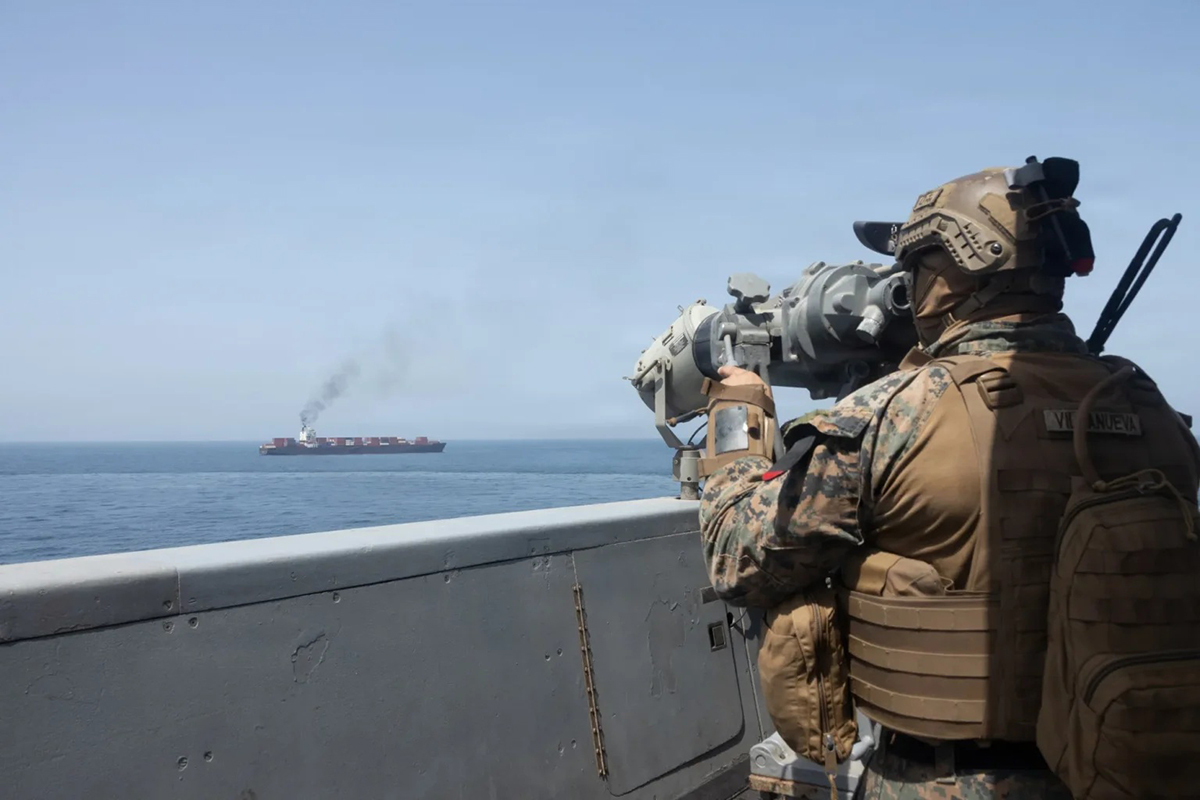
The Strait of Hormuz remains the most sensitive point in this confrontation because its significance extends far beyond the bilateral relationship between Washington and Tehran, directly affecting Gulf states, Asian energy consumers and the global economy. Data from Kpler showed that only four commodity vessels crossed the strait on one day during the latest escalation, down from 10 the previous day and compared with an average of around 13 over the preceding 10 days. Iran’s Revolutionary Guards have said that U.S. strikes would lead to tighter restrictions on maritime traffic through a waterway that, before the war, carried roughly one-fifth of global oil consumption.
The impact of instability around Hormuz is no longer measured solely by the number of ships crossing the waterway. Energy companies have begun adjusting transportation methods and routes in response to heightened risks. The region has witnessed unusual ship-to-ship transfers of Qatari and Emirati liquefied natural gas outside the strait to ensure deliveries to markets including India and Japan. Such measures demonstrate how the conflict is already producing structural adjustments in energy trade even during periods when the intensity of military operations declines.
Hormuz therefore serves a political function for both sides. Washington seeks to prevent the waterway from becoming a permanent instrument through which Iran can exert pressure on global trade and energy flows, while Tehran regards its ability to influence traffic through the strait as an important source of leverage against military and economic pressure. Yet prolonged disruption does not impose costs on only one side. Iran’s economy also relies on maritime access, while Washington must account for the impact of higher energy prices on the U.S. economy and domestic political conditions.
Brent crude rose to $95.63 a barrel on September 2, while U.S. crude climbed to $91.01 as renewed military operations revived concerns over Middle Eastern supply disruptions. At the same time, increased Iraqi exports, supplies from other producers and the use of alternative routes have helped limit the scale of the disruption, leaving markets volatile rather than triggering a complete breakdown in supply.
These developments place regional governments in a particularly sensitive political position. The presence of U.S. military bases and facilities in Iraq, Bahrain, Kuwait, Jordan and elsewhere gives Washington a broad regional military posture but also places those locations within the scope of Iranian retaliatory calculations. At the same time, several Gulf economies remain heavily dependent on stable maritime routes and uninterrupted oil and gas exports, meaning that any widening of the conflict would have consequences extending far beyond the immediate objectives pursued by either Washington or Tehran.
These concerns have encouraged several Gulf states to press for de-escalation, according to regional diplomats cited by Reuters, even in cases where governments may view a reduction in Iranian military capabilities as favorable to their own security interests. Strategic differences with Tehran do not alter the fact that a prolonged confrontation around the Strait of Hormuz, regional military bases and energy infrastructure could impose financial and security costs unrelated to the political objectives of individual Gulf governments.
Iran, meanwhile, has sought to prevent its political isolation from major non-Western powers. That effort was visible during meetings of the Shanghai Cooperation Organisation, where Pezeshkian met leaders from China, Russia and India. The organization issued a statement condemning strikes on Iranian territory and supporting Iran’s right to the peaceful use of nuclear energy. Such political support, however, does not necessarily imply that these states endorse every Iranian policy or would be prepared to confront Washington on Tehran’s behalf, just as the United States’ close relationships with Gulf governments do not mean that their interests are fully aligned with Washington’s approach toward Iran at every stage of the conflict.
This reflects one of the central political features of the current confrontation: the war is not being fought between two completely unified blocs. Instead, it is unfolding within a wider network of overlapping interests in which international and regional powers support certain positions taken by Washington or Tehran without necessarily embracing all of their objectives. Other states are attempting to preserve security and economic ties with both sides while adjusting their policies in response to energy prices, commercial interests and domestic considerations.
After six months of fighting, the political issue is therefore no longer defined solely by how much military power either side can deploy, but by what political outcome that power can produce. The United States has demonstrated its ability to conduct extensive strikes and impose substantial economic and maritime pressure on Iran. Tehran, meanwhile, has retained the ability to retaliate, threaten U.S. interests and affect traffic through the Strait of Hormuz. Yet neither side has moved toward a stable political settlement, nor has the conflict developed into an unrestricted campaign in which all available military capabilities are being used without restraint.
Managing the intensity of the conflict has consequently become part of the political strategy itself. Washington continues to apply military and economic pressure while calibrating the timing and scale of escalation according to domestic and regional considerations. Tehran continues to retaliate militarily and make use of its maritime leverage while preserving, in its political messaging, room for an agreement that could redefine its relationship with the United States. Under these conditions, periods of relative calm do not necessarily signal an end to the confrontation, just as renewed strikes do not automatically mean that either side has decided to move toward an unlimited war.
The central political dilemma is that the conditions required for a return to stable peace have yet to emerge, while the potential cost of an all-out war remains high for all parties directly or indirectly involved. Between these two poles lies a widening space occupied by limited strikes, sanctions, blockades, military retaliation, threats and incomplete negotiations. That space may continue to define the conflict for as long as both sides believe they can improve their respective positions without crossing the threshold into unrestricted war or accepting the concessions required for a comprehensive settlement.
The current situation, therefore, should not be viewed simply as a temporary pause on the road to peace. It increasingly represents a distinct political phase in which military force coexists with diplomacy, blockades with negotiations, and retaliatory operations with efforts to contain escalation. The duration of this phase will depend on whether Washington and Tehran can translate their military and economic leverage into a political formula acceptable to both. Until then, the confrontation is likely to remain open, constrained by boundaries that continue to shift and that neither side has so far declared an interest in removing altogether.


Comments