
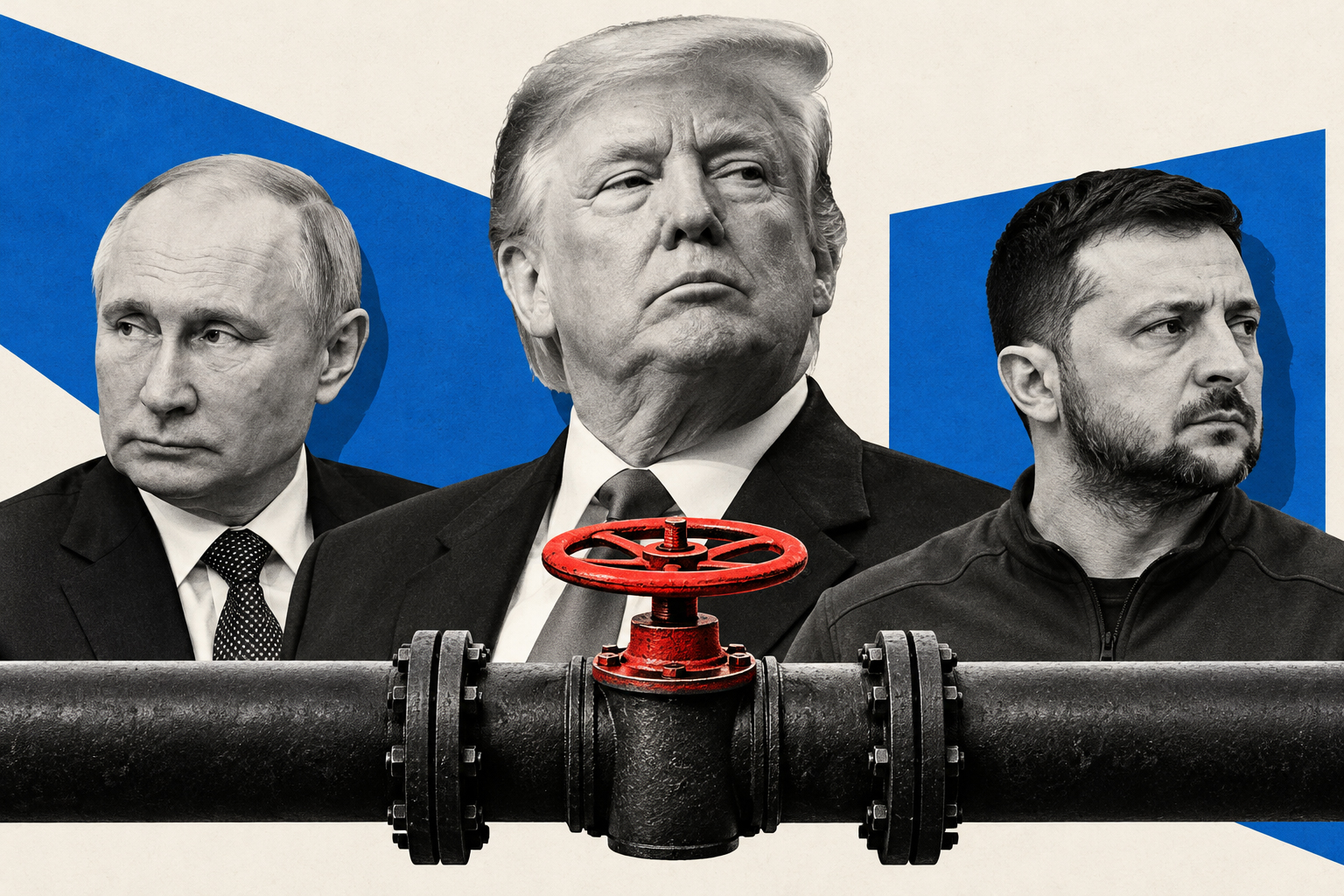




U.S. President Donald Trump announced on October 11, 2026, that Russia and Ukraine had reached an energy truce taking immediate effect, without releasing details of the agreement. Reuters initially reported that there had been no immediate confirmation from either Kyiv or Moscow. The announcement followed a public dispute with Ukrainian President Volodymyr Zelensky over strikes on Russian refineries, linking the protection of energy infrastructure to fuel-price considerations and the future of negotiations.
The significance of the development lies in the convergence of divergent interests around a limited agreement. Washington wants to ease energy pressures and demonstrate its ability to advance a settlement; Moscow stands to benefit from protecting its facilities and facilitating exports; while Kyiv seeks to protect its infrastructure without surrendering, free of charge, an instrument of pressure against its adversary. The implications for Iran will depend on how long the arrangement lasts, how far it expands, and what decisions follow in the Middle East.
Energy as a Point of Convergence for Conflicting Interests
The choice of energy as an entry point for negotiations can be explained by the nature of the sector, where military and economic interests intersect with civilian needs. Halting attacks on specific facilities is easier than reaching agreement over borders, territory, and security guarantees, while allowing each side to present a tangible gain to its domestic audience without declaring a retreat from its broader objectives. A partial truce can therefore create room for negotiations even when the conditions for a comprehensive settlement remain out of reach.
The approaching winter provides an additional incentive to protect electricity and heating infrastructure, since continued destruction would compound repair difficulties and raise the cost of providing essential services. Economically, greater stability in electricity supplies could reduce production disruptions and lessen the need for alternative fuels and emergency spending, giving Ukraine a benefit that extends beyond the humanitarian dimension to the ability of its institutions and society to continue functioning.
On the Russian side, an end to refinery strikes could help stabilize the production of refined petroleum products, reduce repair and protection costs, and lower the risk of disruptions to domestic supplies. Both sides may therefore have practical reasons to accept a limited arrangement while remaining divided over the war itself. A convergence of interests in one area does not imply a comparable convergence of strategic objectives.
The Diesel Deal and Diverging U.S.-Ukrainian Calculations
The truce announcement was preceded by a deal involving Russian diesel, and a U.S. official speaking to Axios linked the agreement to Kyiv’s failure to heed demands that it stop attacking Russian refineries.
This reveals a difference in priorities. Ukraine regards attacks on Russia’s energy sector as a means of increasing the cost of the war, while Washington also measures their consequences by their impact on markets and American consumers.
From Kyiv’s perspective, attacks on refineries can impose costs extending beyond the value of the damaged facility itself, because they may disrupt production and transportation, consume repair resources, and force the adversary to allocate additional protective systems to facilities far from the front line. Halting such attacks therefore represents a negotiating concession that requires something in return, particularly if Russian strikes on Ukraine’s electricity infrastructure continue.
The U.S. calculation, meanwhile, is tied to the way higher diesel prices feed into transportation, agriculture, and goods-distribution costs, and ultimately into the prices paid by households. Seen from this perspective, the administration’s effort to separate certain energy flows from the course of the war can be understood even when doing so creates friction with an ally that regards economic pressure on Russia as part of its defensive capability.
This reveals a broader dilemma in alliance management: a military instrument that is useful to one partner may be economically costly to another. Unless this gap is addressed through a clear understanding over alternatives and compensation, pressure to halt the attacks could reinforce Kyiv’s perception that its security priorities have become subordinate to external political and economic requirements, weakening the trust needed for any subsequent settlement.
The Limits of the Deal’s Impact on Fuel Prices
Reuters reported that the agreement includes the supply of more than 300,000 metric tons of diesel to U.S. and global markets, while analysts questioned whether that volume would be sufficient to produce a significant and sustained decline in prices.
Assessing the deal therefore requires distinguishing between the announcement’s effect on market expectations and the impact of actual supplies once they reach the market.
News of de-escalation may reduce some of the risk premium associated with supply disruptions, but sustaining that effect requires continued improvement in production, exports, and transportation. Redirecting shipments that would otherwise have reached other buyers is also different from adding new volumes to global supply: in the first case, the distribution of supplies changes more than their total volume.
The outcome will also depend on refinery operations, shipping and insurance costs, inventories, and seasonal demand. Over time, the truce’s success in preventing further damage may therefore prove more important than the effect of a limited fuel shipment, because it preserves continuing production capacity and reduces the need to manage repeated crises.
Conversely, if instability in the Middle East continues to weigh on supplies, gains from Russia may offset part of the losses without eliminating the underlying causes of higher prices. The deal would then serve as a tool for easing the crisis rather than resolving it, with a broader solution remaining dependent on wider political and security arrangements.
Pressure for Leadership Change and Its Limits
Trump moved from objecting to strikes on Russian facilities to calling for Zelensky’s replacement, an escalation confirmed in Reuters coverage, though the statement alone does not establish the existence of an operational U.S. plan to remove the Ukrainian president.
Such rhetoric can be interpreted as an attempt to increase the political cost of refusal, place responsibility for stalled negotiations on Kyiv’s leadership, or push it toward greater flexibility.
Personalized pressure, however, can produce contradictory results. It may encourage Zelensky to seek a settlement that preserves the U.S.-Ukrainian relationship, but it may also make concessions more difficult if they become associated domestically with responding to foreign interference in the choice of national leadership. Under such conditions, confrontational rhetoric can narrow the political space available for negotiations rather than expand it.
Changing the individual leading the negotiations also does not necessarily remove the underlying causes of disagreement. Positions on territory, security, and the future of the state extend beyond the president to institutions, political forces, and social constituencies. The assumption that an alternative leadership would automatically accept what Zelensky rejects therefore overlooks the constraints any Ukrainian government would face.
The effectiveness of U.S. pressure will be measured by the measures accompanying it: whether cooperation continues, the nature of the proposals, the substance of the guarantees, and the degree of balance in the obligations demanded from each side. Statements alone leave the relationship exposed to further tension without guaranteeing negotiating progress.
Elections Between Legitimacy and Wartime Conditions
Zelensky announced that he was prepared to hold elections if Russia agreed to a comprehensive 60-day ceasefire, while emphasizing that the choice of national leadership belongs to Ukrainians.
By taking this position, he linked the political process to the prior creation of appropriate security conditions rather than treating elections as a procedure that could be separated from the war.
In practical terms, any credible election requires arrangements that allow participation and campaigning, protect polling stations, and address the circumstances of displaced citizens, those living abroad, and military personnel. Announcing a defined period without fighting therefore opens the debate over whether an election could be organized, but does not by itself establish that the timeframe would be sufficient or that the necessary arrangements could be completed.
Elections enjoying broad acceptance could help renew the political mandate required to make difficult decisions, but holding them under external pressure or amid distorted security conditions could deepen disputes over the legitimacy of the result. An offer to hold elections also does not constitute a pledge to step down, nor does it guarantee the victory of a political trend more willing to accept U.S. or Russian terms.
The energy truce remains separate from this track because protecting refineries and power stations is not equivalent to a comprehensive ceasefire. Moving from sectoral de-escalation to a political process would require a broader and clearer agreement.
Balancing Benefits and Ensuring Implementation
The truce’s durability depends on both sides believing that commitments are reciprocal and enforceable. If Moscow obtains protection for its facilities and export advantages while protection for Ukrainian electricity infrastructure remains ambiguous, Kyiv will find it difficult to defend the agreement. Likewise, reciprocal pledges without a mechanism for dealing with violations may collapse after the first disputed incident.
That begins with defining the facilities covered by the arrangement: refineries, power-generation facilities, transmission networks, storage sites, ports, and related infrastructure. Different definitions of the energy sector could allow each side to accuse the other of violating an agreement interpreted differently, particularly where facilities serve both civilian and military functions.
The truce would also require a clear start time, emergency communication channels, procedures for documenting incidents, and a period for addressing alleged violations before returning to escalation. These are proposed criteria for evaluating the agreement, not publicly announced provisions; the absence of a published text makes it impossible to assume that they are included.
One possible balancing mechanism would be to link continued economic facilitation to continued compliance on the ground. If benefits can be reviewed following violations, the cost of abandoning the understanding rises. Granting those benefits in advance without clear conditions, by contrast, could reduce the mediator’s leverage in securing subsequent commitments.
Moscow’s Gains and the European Role
Moscow may secure direct economic gains from the understanding by protecting production and facilitating sales, as well as political benefits through expanded engagement with Washington. The significance of those gains could increase if limited fuel arrangements evolve into recurring cooperation, giving multiple economic and political actors a stake in maintaining the understanding.
Sustaining those benefits, however, requires a reciprocal contribution capable of preserving the agreement. If economic opening is tied to reduced attacks on Ukrainian infrastructure, the truce becomes an exchange whose implementation can be evaluated. The absence of such reciprocity would strengthen objections and increase the likelihood of restrictions or reversal.
In this context, Europe’s role becomes important in broadening Kyiv’s options and reducing its dependence on any single political decision. Support becomes more consequential when translated into financing, defensive capabilities, and assistance in repairing infrastructure, because such tools give the Ukrainian leadership greater room for negotiation and reduce the societal cost of continuing the war.
European participation in implementation arrangements could also increase Kyiv’s confidence in the truce, but it may create disputes over burden-sharing and relations with Moscow. Any broader agreement would therefore require coordination among Ukraine’s supporters to prevent a proposed settlement from becoming another source of division among them.
U.S. Elections and the Pressure for Quick Results
The U.S. initiative is also connected to pressure from fuel prices ahead of the midterm elections, a link addressed by Reuters in its coverage of the agreement.
The timing creates an incentive to announce quick results, while the economic effects require more time for supplies to move, expectations to stabilize, and the impact to reach consumers.
The difference between the political and economic timelines could raise expectations beyond what the deal is capable of delivering. If prices fail to decline as quickly as anticipated, the initiative could shift from an achievement promoted by the administration to a subject of scrutiny over what was conceded to Russia and what was received in return.
Disagreement with Zelensky also does not guarantee that the U.S. political system will unite behind the president. Objections to easing pressure on Moscow could increase the political cost of the arrangement. Its domestic success therefore depends on achieving two outcomes simultaneously: an economic benefit felt by voters and diplomatic progress that can be defended as the result of reciprocal concessions.
Iran and the Intersection of Energy and War
The connection to Iran begins with the transmission of Middle East instability into the global economy. Reuters has reported on the pressures exerted by the war on energy, inflation, and growth ahead of meetings of the International Monetary Fund and the World Bank.
This interdependence means Washington can seek to reduce economic losses in one arena even when it is unable to eliminate their underlying causes in another.
From this perspective, three possible pathways can be identified for the agreement’s impact on Iran. These are analytical possibilities, not established outcomes.
The first is that improved Russian supplies could reduce some of the economic costs constraining Washington’s options, giving it additional flexibility in managing the confrontation with Tehran. That, however, would require sustained and significant flows and would not follow automatically from the announcement of a limited truce.
The second possibility is that the deal’s limited impact could demonstrate that resolving the fuel crisis remains dependent on calming the Middle East itself. In that case, the need for stable prices could encourage broader negotiations with Iran or regional arrangements aimed at reducing supply disruptions, rather than using Russian gains to expand escalation.
The third concerns Moscow’s calculations. New channels of cooperation with Washington could give Russia an incentive to balance its relationships and interests across several arenas. But concluding that Moscow would abandon Tehran would require independent evidence of changes in its diplomatic behavior or practical cooperation, because states can expand understanding in one area while maintaining disagreements and partnerships in others.
Iran’s ability to influence developments also remains tied to factors extending beyond the volume of fuel available, including the course of the war, transportation security, insurance costs, and the calculations of regional actors. Increased Russian supplies may therefore alleviate part of the pressure, but they do not determine Iran’s position or the future of its political system, nor do they provide a basis for describing the developments as the “end of Iran.”
Scenarios and the Conditions for Their Realization
Three possible trajectories can be identified, while any assessment of their likelihood remains dependent on the emergence of clear implementation conditions.
The first is the continuation of a limited truce protecting energy facilities while the war continues in other areas. This scenario requires the least comprehensive political agreement, but it still depends on controlling violations and preventing battlefield disputes from spreading to protected infrastructure.
The second is a gradual expansion of the truce into broader negotiations if reciprocal compliance produces tangible benefits and demonstrates that the parties can implement their commitments. Further arrangements could then be built upon it, although territorial issues and security guarantees would remain more complex and costly than an agreement to protect specific facilities.
The third is the failure or collapse of implementation because of ambiguous obligations, an imbalance of benefits, or renewed attacks. Such an outcome could restore pressure on markets and intensify disagreement between Washington and Kyiv, particularly if the parties trade accusations over responsibility. It could also make subsequent negotiations more difficult if a belief takes hold that economic concessions do not guarantee reciprocal action on the ground.
Several indicators provide a basis for evaluating these scenarios: matching confirmations from both parties, publication of the scope of protection, an actual decline in attacks, stable supplies, and the emergence of a mechanism for addressing incidents. The consequences for Iran, meanwhile, should be measured by decisions directly affecting Tehran, not merely by an improvement in U.S.-Russian communication.
Conclusions
- The energy truce reflects a temporary convergence of interests: Washington benefits from easing fuel pressures, Moscow from protecting production, and Kyiv from safeguarding essential services. Its prospects for continuation increase when those benefits are distributed in a balanced manner.
- The strength of the agreement depends on its enforceability: The announcement represents a political beginning, while definitions, monitoring, and mechanisms for addressing violations will determine whether it can alter conditions on the ground and build sufficient trust to expand negotiations.
- Pressure on Zelensky carries negotiating costs: It may encourage greater flexibility, but it could also make concessions more difficult to defend domestically, while the underlying causes of disagreement extend beyond the personality of the president.
- The economic impact requires sustained supplies: The value of the deal will depend on its ability to protect production, increase supply, and reduce market disruption, while Middle East crises continue to influence the final outcome.
- The implications for Iran remain multidirectional: An improvement in energy markets could give Washington greater flexibility or demonstrate the need for broader regional de-escalation. The actual trajectory will depend on subsequent decisions, the interests of the parties, and the persistence of economic pressures.


Comments