




Introduction
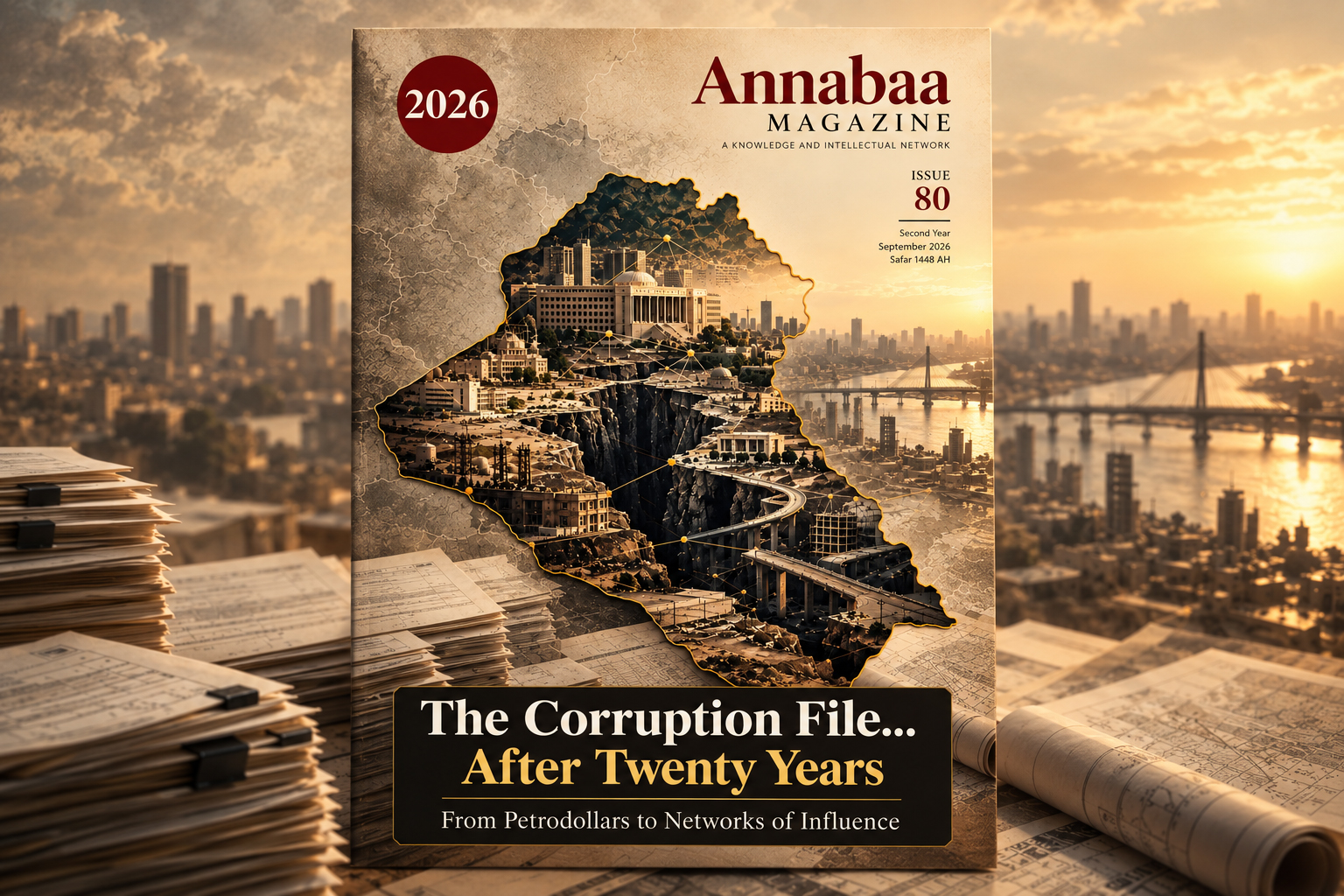
In January 2006, Annabaa Magazine devoted its 80th issue to an extensive special file on corruption in Iraq. At the time, the country was still in the early years of its new political system, and state institutions remained in the process of reconstruction. The file therefore read as an early warning about a future that could still be avoided if corruption was confronted before evolving from individual practices into a political, economic and social system.
Twenty years later, revisiting that file reveals that most of the phenomena it identified have not disappeared. Instead, they have expanded, evolved and become more organized and more capable of protecting themselves. The partisan patronage the file warned against became one of the main gateways to the distribution of positions and public-sector jobs. Limited manipulation of tenders developed into complex networks operating through contracts and projects. Weak oversight, once regarded as a temporary institutional deficiency, has in many cases evolved into a structural gap between the existence of oversight institutions and their actual capacity to enforce accountability.
Iraq, however, has not remained entirely in the same place. Over the past two decades, institutions, laws and specialized courts have been established, government digitization has expanded, and new judicial and oversight expertise has emerged. The question raised by this comparison is therefore not whether progress has taken place, but why institutional progress has remained slower than corruption’s ability to adapt and expand.
First: What Did the 2006 Special File on Corruption Say?
The file contained seven articles examining corruption from intellectual, administrative, legal, political and field-based perspectives. It did not treat corruption as merely petty bribery or an individual moral deviation, but as a dysfunction in the relationship between authority and society and in the structure of the state itself.
Its main themes can be summarized as follows:
1. Corruption as a Relationship Between Authority and Society
In his article A Perspective on Corruption, Alaa Hamid argued that corruption is not limited to the unlawful acquisition of money. It becomes a social relationship that violates the public interest and can gradually turn into a normalized feature of political and administrative culture.
The article linked the expansion of corruption in Iraq to the historical imbalance between authority and society, the absence of transparency, and the exclusion of the public from monitoring contracts, decisions and public resources.
Its most significant warning concerned the rise of “partisan patronage” at the expense of competence and professionalism, and the potential emergence of what it called a “dictatorship of political parties,” in which parties restrict employment and participation opportunities to their own members and supporters.
The article also observed at an early stage that corruption could become a means of attaining and preserving political status rather than merely a by-product of political activity.
2. Distinguishing Between Petty and Grand Corruption
Yasser Khalid Barakat al-Waeli’s article, Administrative Corruption: Its Concept, Manifestations and Causes, presented a comprehensive definition of corruption as the abuse of authority or public office for private gain.
It distinguished between petty corruption, including bribery, favoritism and manipulation of administrative procedures, and grand corruption associated with major contracts, arms deals and senior government positions.
The article also divided corruption into political, financial, administrative and ethical forms, arguing that these do not operate independently but reinforce one another. When the political system becomes corrupt, administration weakens; when administration weakens, financial corruption expands; and when corruption becomes normalized, the value system itself begins to justify it.
The article proposed practical solutions, including simplifying procedures, setting deadlines for completing transactions, adopting merit-based recruitment, establishing an independent oversight system, restructuring salaries, improving public services, strengthening transparency and reforming workplace culture.
Its key conclusion was that anti-corruption efforts cannot succeed through fragmented measures. They require comprehensive reform of administrative structures, human resources and working methods.
3. Corruption as a Product of the Quality of Governance
Dr. Nasser Obeid Nasser’s article, Deconstructing the Phenomenon of Corruption, offered the broadest institutional analysis in the file.
It linked the fight against corruption to good governance based on accountability, transparency, participation, balance among branches of government and judicial independence.
The article warned against parliament turning into an intermediary for services and appointments rather than an institution responsible for legislation and oversight. It also warned that political parties could shift toward dividing wealth and power among themselves rather than competing through political programs.
It further cautioned against the co-optation of civil society and the media, and against the selective use of oversight institutions or their transformation into instruments of political pressure.
The article advanced several forward-looking recommendations, including:
Strengthening judicial independence and maintaining a balance among branches of government.
Activating parliamentary oversight of the budget and its implementation.
Adopting a parliamentary code of conduct preventing conflicts of interest and political mediation in contracts and appointments.
Regulating electoral campaign financing.
Reforming the civil service and salary structure.
Establishing independent and specialized anti-corruption bodies.
Enabling the media and civil society to access information.
Involving citizens in oversight of government authority.
Addressing the environment that produces corruption rather than merely prosecuting selected individuals.
The article’s most important conclusion was that political will is the key to fighting corruption, and that plans and laws become largely symbolic procedures if those in power are unwilling to apply them to their allies before applying them to their opponents.
4. Corruption as a Consequence of State Collapse After 2003
Ali Watout’s article, The Phenomenon of Corruption in Iraq, focused on the circumstances surrounding the occupation and the collapse of state institutions.
It linked the spread of corruption to the security vacuum, weakened sovereignty, lack of transparency and absence of legal accountability.
The article noted that major decisions, budgets and contracts were handled with little public scrutiny, and that the absence of transparent rules governing contracts and tenders created a favorable environment for corruption.
It also linked weak judicial institutions and the absence of meaningful prosecutions to a growing sense among corrupt actors that they could escape punishment.
The article, however, moved beyond political factors to address cultural ones.
It discussed the declining respect for public funds, the blurring of private and public interests, and the transformation of bribery, commissions and brokerage into a parallel system of incentives.
Here, the special file offered an early diagnosis of one of corruption’s most dangerous consequences: public employees losing faith in the value of their salaries and legitimate work, while illicit income becomes the real objective and formal employment merely the mechanism through which it is obtained.
5. Corruption as a System Shaped by Multiple Factors
Mazen Mursal Mohammed’s article, On Corruption and Its Various Effects, approached corruption from legal, social and ethical perspectives.
It emphasized that corruption does not merely damage public finances; it undermines the rule of law, weakens the judiciary and alters social behavior.
Drawing on the United Nations Convention against Corruption, the article also identified various forms of corruption-related crime, including bribery, embezzlement, abuse of office, money laundering and illicit enrichment.
6. A Field-Level Examination of Contract and Project Networks
A report by the Imam Shirazi Center for Studies and Research, supervised by lawyer Jamil Awda, came closest to a field investigation.
It described interconnected networks operating within ministries, municipalities, security agencies, companies and political parties, identifying bribery, abuse of influence, embezzlement, nepotistic appointments and the waste of public funds as major manifestations.
The report exposed methods used to manipulate tenders. These included leaking bidding information to a selected contractor so that the contractor could submit an offer marginally below competing bids in exchange for a share of the profits; awarding projects to contractors connected to officials; implementing fictitious or substandard projects; and withholding information concerning sources of financing, project costs and implementing companies.
It recommended scheduling projects according to citizens’ actual needs, publicly disclosing companies and costs, establishing multi-agency committees to supervise tenders, monitoring implementation to ensure compliance with contracts, holding those involved accountable, and publishing tender procedures and deadlines through the media.
7. Waste and Excessive Spending as Another Form of Corruption
Wijdan Falih al-Saadi’s article distinguished between direct theft and waste resulting from poor planning and unproductive spending.
Public money may be lost through embezzlement, but it can also be wasted on unnecessary, stalled or excessively costly projects.
The special file therefore broadened the definition of corruption to include inefficiency and poor prioritization rather than limiting it to financial crime.
Second: What Changed Between 2006 and 2026?
The central paradox is that Iraq has developed substantially in formal and legal terms without achieving a comparable transformation in outcomes.
Iraq scored approximately 28 out of 100 on the 2025 Corruption Perceptions Index, ranking 136th out of 182 countries.
The result represents limited improvement, but it continues to reflect weak confidence in institutions’ ability to apply rules consistently and without selectivity.
The United Nations Development Programme has argued that reform has become increasingly visible, but confidence in its sustainability has yet to become firmly established.
A National Anti-Corruption Strategy for 2025–2030 was also prepared after the 2021–2025 strategy. As of February 2026, however, it was still awaiting formal approval.
This demonstrates progress in strategic planning, but at the same time reflects the persistence of the gap identified in the 2006 file between drafting plans and transforming them into a stable institutional system.
In the judicial sphere, Iraq now has a Central Criminal Court for Combating Corruption, specialized judges, a judicial code of conduct, financial disclosure requirements and mechanisms for cooperation among the judiciary, the Federal Commission of Integrity and the Federal Board of Supreme Audit.
Nevertheless, a 2026 study published by Iraq’s Supreme Judicial Council acknowledged shortcomings in technical legislation, an insufficient number of judges, inadequate modern investigative tools and limited specialized training.
An asset-recovery report published in June 2026, based on a review of 482 criminal cases and 60 civil lawsuits, also found a continuing gap between securing convictions and actually recovering stolen assets.
This means the state may punish an individual without necessarily recovering the money whose loss deprived the country of services and infrastructure.
Third: Did the Ideas Presented in the 2006 File Materialize in Today’s Reality?
Yes — and strikingly so.
The file did not offer detailed predictions, but it identified the mechanisms that eventually contributed to the present situation:
It warned against partisan patronage, which today remains one of the principal gateways to employment, influence and the allocation of public positions.
It linked corruption to institutional weakness rather than merely to individual moral failure, an understanding now reflected in the way international institutions describe corruption as a governance crisis.
It warned that political parties could become groups focused on dividing wealth and power rather than competing on policy programs.
It identified methods of tender manipulation at an early stage that continue to recur today in more complex forms.
It called for public disclosure of contracts, companies and project costs, which remains among the most important transparency requirements in 2026.
It warned against selective oversight, because prosecuting lower-level offenders while protecting powerful centers of influence does not dismantle the corruption system.
It linked corruption to declining trust, weaker work incentives and reduced productivity, consequences now visible in weakened confidence in institutions and difficulties attracting productive investment.
The file, however, was also a product of its time.
It placed considerable emphasis on corruption associated with the occupation and the institutional vacuum that followed 2003.
By 2026, corruption had become more domestically rooted and more institutionalized. It could no longer be explained solely by the occupation or the collapse of the state.
Responsibility gradually shifted toward the Iraqi political forces that managed the state and public finances over the following two decades.
Fourth: Why Did Governments, Parties and Elites Fail to Learn the Lessons?
The failure cannot be reduced to a lack of knowledge, because the diagnosis was already available during the first years of the new political system.
The deeper problem was that genuine reform conflicted with the way power and benefits were distributed.
1. Corruption Shifted From a Dysfunction to a Method of Managing Alliances
When jobs, contracts and projects are used to secure political loyalty, corruption becomes part of the mechanism through which governing coalitions are constructed.
Fighting it is then no longer an administrative decision. It becomes a threat to the balance on which political power itself depends.
2. Conflicts of Interest Affect the Institutions Tasked With Reform
Governments have instructed oversight agencies to combat networks that may themselves be connected to political forces participating in the government or parliament.
As a result, oversight has frequently remained constrained by the limits of political consensus.
3. Anti-Corruption Efforts Were Reduced to Arresting Individuals
Official discourse has repeatedly focused on arresting an employee, director or official.
Yet the 2006 file warned that corruption was produced by a political and administrative environment.
Replacing an individual while leaving unchanged the rules governing appointments, contracts, financing and oversight simply reproduces the problem.
4. Corruption Cases Became Instruments of Political Conflict
Corruption accusations have at times been used to weaken political rivals, while cases lose momentum when alliances change.
This selectivity weakens deterrence and convinces the public that the law is not applied equally to everyone.
5. Weakness of Sustained Public Pressure
Protests and demands have increased, but they have not always developed into independent oversight institutions capable of monitoring budgets, contracts and projects over the long term.
Journalists, researchers and whistleblowers have also faced pressure that limits their ability to expose wrongdoing and continue their work.
6. The Rentier Economy
Large oil revenues gave successive governments the ability to postpone reform.
The state could continue financing salaries and benefits and absorbing crises without rebuilding a productive economy subject to meaningful tax accountability.
In a rentier state, the financial relationship between citizens and government is weaker, and with it comes weaker scrutiny over precisely how public money is spent.
7. Institutional Proliferation and Fragmented Responsibility
The existence of numerous institutions does not necessarily create an integrated integrity system.
When the responsibilities of the Commission of Integrity, the Board of Supreme Audit, ministries, parliament and the judiciary overlap, accountability can become lost among referrals, investigations, audits, prosecutions and enforcement.
8. Weak Institutional Memory
Each government approached anti-corruption efforts as though it were starting from the beginning, introducing new committees, strategies and slogans instead of reviewing what had been implemented from previous plans and identifying responsibility for their failure.
As a result, recommendations were repeated while reform failed to accumulate.
Fifth: Which Recommendations From the 2006 File Remain Relevant?
With updated tools, most of the recommendations remain applicable.
1. Move From General Transparency to Detailed Transparency
Publishing aggregate budget figures is not enough.
Contracts, annexes, amendments, costs, company names, beneficial owners, completion rates, payments and the reasons for project suspension should all be publicly disclosed.
2. Digitize the Entire Public-Finance Cycle
Budgets, contracts, tenders, customs, taxation, salaries, pensions and state-owned property should be connected through an auditable digital system.
Digitization reduces direct contact and petty corruption, but it cannot prevent grand corruption without independent oversight and clear rules.
3. Prevent Conflicts of Interest
The parliamentary code of conduct proposed in the 2006 file should be updated and transformed into binding law preventing officials, members of parliament, their relatives and business partners from benefiting directly or indirectly from contracts and privileges over which they exercise influence.
4. Subject Political Party and Election Financing to Audit
Administrative corruption cannot be effectively addressed without knowing where political parties obtain their funding, how much election campaigns cost, and what relationships connect political forces with companies and contractors.
5. Protect Whistleblowers, Journalists and Witnesses
Without meaningful protection, knowledge of corruption inside institutions will remain constrained by fear of dismissal, threats or retaliation.
6. Measure Recovered Assets, Not Merely the Number of Cases
Success should not be measured solely by arrest warrants, referrals and convictions.
It should also be measured by the amount of money and assets returned to the public treasury and by the number of projects rescued from waste.
7. Establish Public Oversight of Projects
Local platforms should allow citizens to know a project’s cost, duration, implementing company and completion rate, while enabling them to report delays, poor quality or deviations from specifications.
8. Reform the Civil Service
Iraq needs a professional civil service council, clear job descriptions, performance evaluation, and recruitment and promotion based on competence.
Appointments made as political quotas or as instruments for satisfying partisan constituencies should end.
9. Ensure the Independence of Oversight Institutions
Oversight bodies should have financial and administrative independence.
Their reports and follow-up findings should be made public, while their leadership should be protected against dismissal or political pressure because of the cases they investigate.
10. Turn Anti-Corruption Into a State Policy
Anti-corruption policy must be separated from the lifespan of individual governments and shifting political alliances.
It should be linked to a ten-year plan with measurable targets, independent annual assessments and public accountability for failures.
Sixth: How Might We Read This Report Twenty Years From Now, in 2046?
How this report will be read in 2046 will depend on one of three possible trajectories.
Scenario One: Repeating the Warning
If selective enforcement continues and patronage networks remain stronger than institutions, the 2026 report will look much like the 2006 file: an accurate diagnosis and reasonable recommendations that were never converted into political will.
In such a scenario, corruption will no longer represent merely a drain on public funds. It will become a factor weakening the state in the face of demographic and climate pressures and the declining capacity of the oil economy to finance expanding public expenditures.
Scenario Two: Partial Improvement While Grand Corruption Persists
Digitization may succeed in reducing everyday bribery and simplifying public services, while major contracts, political financing, border crossings and state property remain vulnerable to influence networks.
Under this scenario, citizens’ interactions with the administration improve, but the fundamental structure through which wealth is distributed does not significantly change.
Scenario Three: The Transition to a State of Institutions
This trajectory becomes possible if rules become stronger than individuals, the entire public-finance cycle is disclosed, public employment is separated from party loyalty, political financing is brought under scrutiny, stolen assets are recovered, and the judiciary, whistleblowers and the press are protected.
Future generations could then read the 2006 file and the 2026 report as part of a long period of institutional learning that ultimately resulted in the construction of a state with greater integrity.
Conclusion
The value of Annabaa Magazine’s special file twenty years later lies in demonstrating that Iraq’s corruption crisis was never unknown and that warnings were never lacking.
The file identified, at an early stage, partisan patronage, the division of political spoils, weaknesses in parliament and the judiciary, opaque contracts, lack of access to information, waste of resources and declining respect for public money.
It also proposed solutions that remain relevant today.
The experience between 2006 and 2026, however, demonstrates that knowledge alone does not produce reform.
The problem was not the absence of advice, but the absence of political consensus on accepting the cost of implementing it.
Fighting corruption means depriving influential actors of resources, positions and contracts that help sustain their power. As a result, reform remained concentrated around the edges of the system without reaching the core relationship between money, political authority and party power.
The most important lesson for the future is that Iraq does not need another report proving that corruption exists as much as it needs a system that makes public money harder to conceal, abuse of public office more costly, recovery of stolen assets faster, and enforcement of the law non-negotiable.
If that does not happen, 2046 may arrive only to confirm that the country lost not merely money, but forty years of opportunities for construction, development and public trust.


Comments